






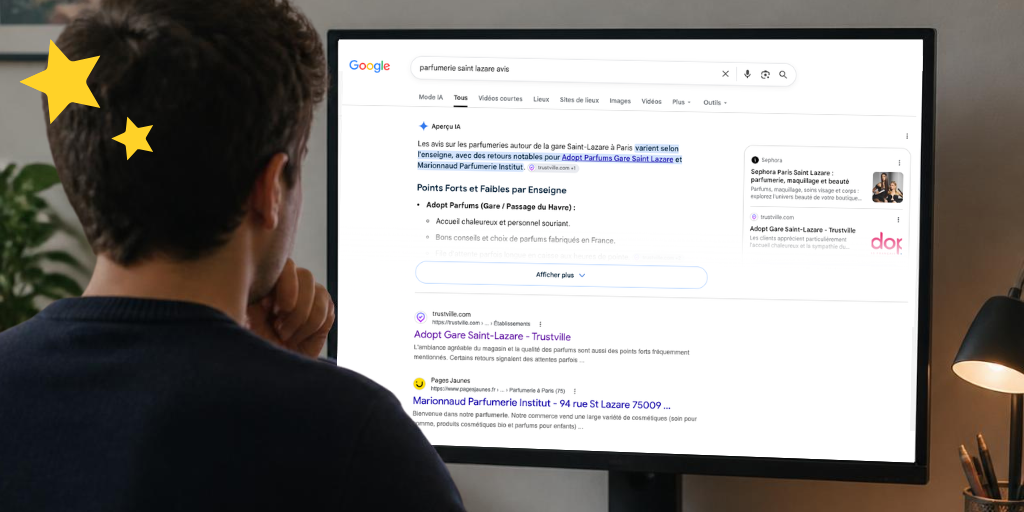
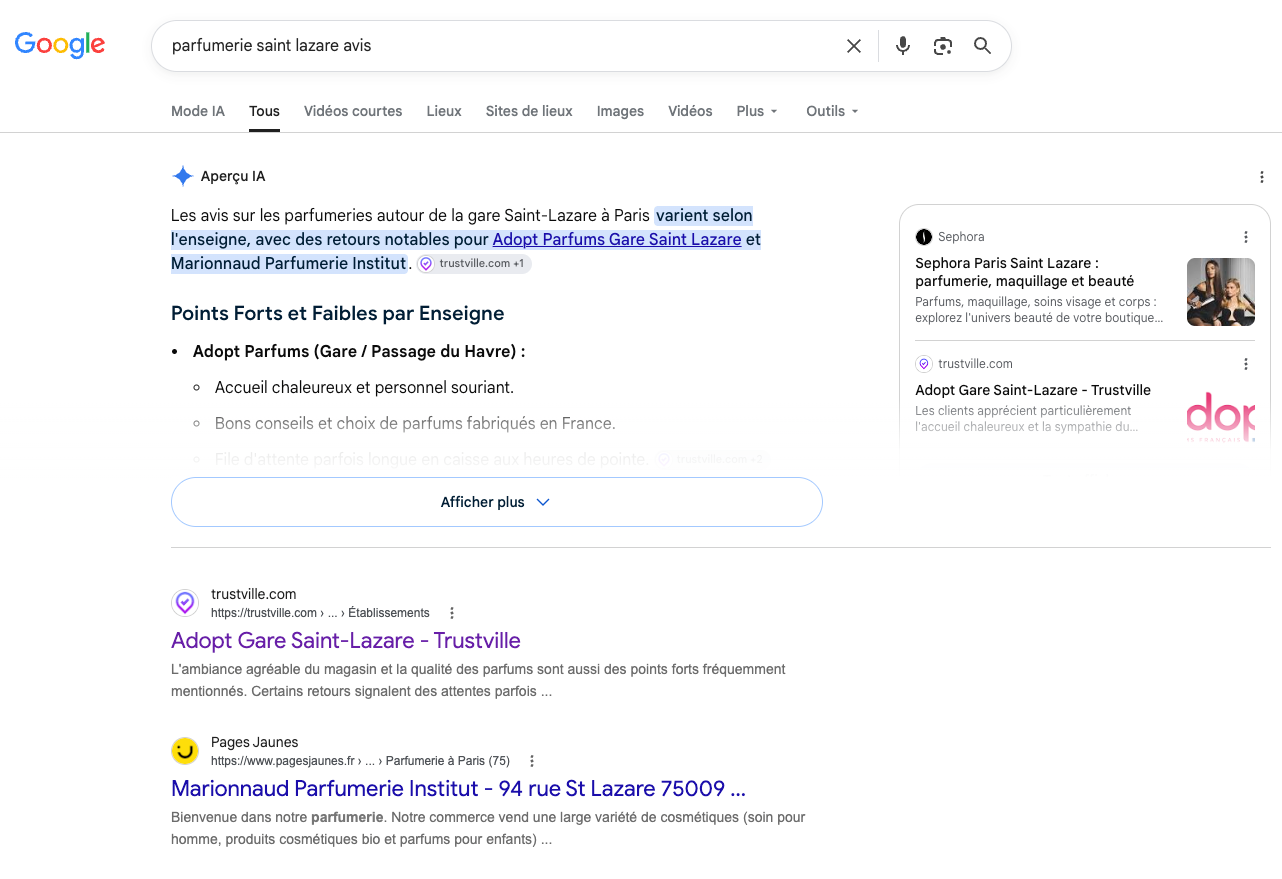
On 22 July 2026, Google began rolling out AI Overviews in its search results in France.
When someone runs a search, Google can now show a summary generated by its AI, Gemini, above the usual list of links.
For retailers, the challenge has shifted: ranking among the top results no longer guarantees that searchers visit their website. They now need to aim to be quoted directly in the AI-generated answer.
What is AI Overviews?
AI Overviews is a Google feature that combines several sources into a single answer shown directly on the results page.
Where traditional search ranked links, Google now provides one answer, built from several pieces of content it considers relevant.
To produce this summary, Google cross-checks different sources to understand a brand, its offers and its stores.
AI Mode, the conversational counterpart of AI Overviews
AI Overviews was not the only launch in July 2026: AI Mode arrived in France on the same day.
Where AI Overviews adds a summary above the usual results, AI Mode replaces the search experience with a tab of its own, where users talk to Gemini conversationally. They can ask a follow-up question, refine their request or compare several options without starting again.
To produce its answers, AI Mode breaks the original query down into several sub-queries handled at the same time (known as "query fan-out"), then selects the most relevant sources for each one.
For a local retailer, the challenge is similar to that of AI Overviews, but at a finer level: visibility is no longer decided only at page level, but at the level of the passage or section that precisely answers a given sub-query.
The new opt-out setting in Search Console
In response to publishers' concerns, Google introduced a setting in Search Console that lets each website choose whether or not to feed AI answers.
Once this setting is switched on, the site no longer appears in AI Overviews, AI Mode or the summaries generated in Discover. It does, however, continue to be indexed and ranked normally in traditional search results and in Discover: Google states that this choice is not used as a ranking signal.
When this article was written, in August 2026, the setting was still being tested and rolled out gradually, first to some sites in the United Kingdom, and it only allowed a single choice for the whole site, with no page-by-page control. Its extension to all markets, including France, had not been confirmed.
For local retailers, this setting raises a strategic question more than a technical one. Opting out of AI answers means giving up a discovery channel that searchers use more and more, without improving your position in traditional results. For the vast majority of multi-site networks, whose aim is precisely to be identified and cited in these answers, leaving the setting on "included" remains the most consistent default.
What AI Overviews changes for local retailers
An AI answer at the top of the page can directly reduce traffic to organic results.
According to an Ahrefs study (in French), when Google displays an AI answer, the average click-through rate of the page in first position can fall by 58%.
For a local retailer, the impact goes beyond clicks. For searches such as "perfume shop Rennes" or "sports shop near me", Google can now generate a summary before the searcher even looks at the traditional results or Google Maps.
This answer can highlight particular stores, their services, opening hours, location or what sets them apart.
AI Overviews does not always replace Google Maps. It can, however, capture attention earlier and influence which stores the user then looks at.
A retailer's visibility therefore now depends on its ability to be understood and selected in the generated answer.
For a multi-site network, Google needs to clearly identify:
- the brand;
- its offers;
- its stores;
- the information specific to each store;
- the experiences customers have had.
Incomplete listings, out-of-date information or unreliable reviews can limit a store's presence in the AI answer, even if it remains visible in traditional results.
From SEO to GEO
GEO, or Generative Engine Optimisation, covers the practices that make a brand more visible in the answers produced by generative engines.
Where SEO aims to move a page up the results, GEO aims to make content clear enough, credible enough and usable enough to be picked up by an AI.
This approach relies on three main levers:
- clear, structured information;
- identifiable sources and signals of trust;
- data that machines can easily interpret.
The aim is for engines not only to understand the information, but also to consider it reliable enough to cite.
Why verified customer reviews are becoming essential
Verified customer reviews are becoming essential because they give AI engines dated, store-specific evidence of real customer experiences to select and cite.
The arrival of AI Overviews reinforces a trend already visible with ChatGPT and Claude: engines select, cross-check and rephrase the information they consider useful.
The difference matters for local retailers, because this answer appears directly in Google, at the very moment a consumer is looking for a store.
Verified customer reviews provide concrete data linked to a real experience:
- proof of purchase or experience;
- a date;
- a specific store;
- a rating;
- a comment with context.
They document the quality of the welcome, the advice, and the products or services offered locally.
For a generative engine, this material can help tell apart several stores in the same area, or several stores of the same retailer.
Recent, reliable reviews correctly linked to each store strengthen the information Google uses to understand what the store really offers, what sets it apart and in which situations customers recommend it.
They do not guarantee an appearance in AI Overviews. They do, however, increase the quantity and quality of data available to describe the store and make it credible.
Verified reviews are thus becoming a raw material of local GEO. They no longer serve only to reassure and convert: they also help make each store more visible in generative search environments.
This development extends the findings of our article "Verified customer reviews, the fuel of GEO": the same data feeds generative engines, but its direct integration into Google can strengthen its impact on local visibility.
Prepare your local visibility for the age of AI
With AI Overviews, your visibility no longer depends only on your position in search results. It also depends on the quality, reliability and readability of the information available about your brand and your stores.
This is precisely the challenge we anticipated when we developed Trustville (in French), launching, on the same day Google launched AI Overviews in France, new brand and store pages with AI summaries, which highlight the key features of a store and a brand, along with enhanced structured data. Find out in our dedicated article how Trustville is evolving to strengthen retailers' local visibility.
Would you like to assess how well your customer reviews can strengthen your visibility in these new search environments? Let's talk about your local visibility strategy.




