



Consumer services

Make every interaction a reason to trust you.

From first contact to renewal, Wizville turns the voice of your customers, members, users and relatives into concrete actions for your local teams.

ChatGPT Image 22 août 2026, 16_38_17-1
Network listening 150 000+ reviews collected in ten months at Fitness Park — figures presented in the customer story
73% of reviews handled in under 72 hours (Fitness Park customer story)

Service networks that make trust a team matter

5àsec O2 Fitness Park La Maison Bleue AXEO Services Iron Bodyfit Centre Services JOA Chaîne Thermale du Soleil Emera

Your sectors

A platform tailored to every service business

The management foundation is shared, but the moments of truth are not: a dry cleaner, a home-care agency, a gym, a nursery, a senior residence or a spa resort do not listen to the same audiences, nor at the same pace. Select your sector.

Garment care & local services

Keeping a promise of turnaround time and results on an item the customer has entrusted to you. The experience is played out at drop-off and collection, and dissatisfaction is often emotional: the item has a value, sometimes a sentimental one. Management must distinguish result, turnaround, welcome and price, and make consistency visible from one store to the next, including across countries.

Moments of truth
  1. Local search and first contact
  2. Drop-off and qualifying the need
  3. Promised turnaround and price
  4. Collection and checking
  5. Possible complaint
  6. Return to the store after an incident
Pain points to detect
  • Deadline announced then missed, with no information
  • Result judged insufficient on a valuable item
  • Loss or damage, handled too slowly
Indicators tracked
Satisfaction after collection, by storeAnnounced turnaround metResult / turnaround / welcome / price themesResolution time and local public rating

Home services

Bringing a service into the customer's private space, with the reliability and discretion this demands. The punctuality and continuity of the care worker weigh as much as professional skill, and the relationship with the agency counts as much as the visit itself. A point of vigilance specific to this business: the customer, the beneficiary and the payer are not always the same person.

Moments of truth
  1. Request, qualification and quote
  2. Set-up and first visit
  3. Recurring schedule
  4. Change of schedule or care worker
  5. Invoicing and related paperwork
  6. Complaint, renewal or termination
Pain points to detect
  • Care worker replaced without anyone giving notice
  • Late or missed scheduled visit
  • Request made to the agency, unknown in the field
Indicators tracked
Satisfaction after start-up, then spaced-out pulsePerceived punctuality and continuityCustomer effort (CES)Complaint resolution and visible closure

Fitness, coaching & memberships

A quality that is not judged once but reassessed at every visit: welcome, equipment availability, cleanliness, atmosphere, coaching, digital access and contract management. Declared feedback does not replace attendance data, but it explains WHY the relationship is weakening — something a churn signal alone cannot tell you.

Moments of truth
  1. Trial visit or session
  2. Sign-up and understanding the contract
  3. First workouts
  4. Routine and crowd levels by time of day
  5. Incident, suspension or disengagement
  6. Renewal or cancellation
Pain points to detect
  • Rushed onboarding in the first weeks: the promise is not understood
  • Unavailable equipment or declining cleanliness at peak times
  • Cancellation experienced as an obstacle course
Indicators tracked
Satisfaction by stage: sign-up, first visits, exitPain points by club, time slot and membership tenureDeclared cancellation reasonsClub's public rating and review response time

Early childhood

Daily childcare that rests on families' trust and on the quality of handovers. The respondent is the parent or legal guardian, and what they express is a PERCEPTION: it sheds light on information, settling-in, the relationship with the team and admin. It replaces neither professional observation, nor inspection, nor regulatory assessment — and no young child is ever surveyed.

Moments of truth
  1. Searching for a place and information before starting
  2. Enrolment and paperwork
  3. Settling-in
  4. Daily handovers
  5. Change of team or event
  6. Review and departure
Pain points to detect
  • Insufficient information before starting, poorly supported settling-in
  • Irregular handovers: the parent pieces the day together
  • A concern raised that receives no identified response
Indicators tracked
Parents' perception of information and settling-inPerceived quality and regularity of handoversTrust in the team and understanding of the childcare approachHandling of concerns, with separate escalation for safety signals

Seniors, healthy ageing & spa therapy

Two distinct realities linked by one principle: several people live through the same organisation without having the same experience. In a residence, the resident's voice and the relative's voice are collected separately and do not replace one another. On a spa cure, a guest can be satisfied with the care teams and dissatisfied with coordination. In both cases, the measurement covers the relationship, the organisation and information — never a medical outcome.

Moments of truth
  1. Information, visit and admission or booking
  2. Arrival, settling in and orientation
  3. Daily life: schedules, flow, comfort, cleanliness
  4. Dining, activities and additional services
  5. Keeping relatives informed and coordination between professions
  6. Complaint, end of stay or reassessment
Pain points to detect
  • A relative informed too late, or in place of the person concerned
  • Broken continuity: the context has to be re-explained to every contact
  • A complaint made without the person knowing what became of it
Indicators tracked
Resident voice and relative voice tracked separatelyPerceived respect, dignity, autonomy and informationCoordination of the stay, by stage and by siteComplaint handling: time to take charge and documented closure

Leisure & destinations

The same visitor may dine, attend a show, stay overnight and use a gaming area: multi-experience measurement is the only useful reading here. The restaurant, bar, hotel, show and casino journeys remain distinct, and listening covers welcome, flow, safety and information — never the intensification of gambling, which is governed by obligations to prevent excessive and underage gambling.

Moments of truth
  1. Booking and arrival
  2. Access control and orientation
  3. Dining, bar, accommodation, show
  4. Waiting, flow and atmosphere
  5. Information on responsible gambling
  6. Incident and departure
Pain points to detect
  • Unclear multi-activity offer: the visitor doesn't know where to go
  • Poor waiting times and coordination between two activities
  • Sensitive situation poorly handled on site
Indicators tracked
Satisfaction by experience, never aggregated into a single scoreWelcome, orientation, waiting and cleanlinessPerceived accessibility and safetyQuality of incident handling and local public reviews

The promise is national, but trust is earned locally.

In services, the experience is the product. Punctuality, listening and continuity determine perceived value. Whether it concerns a garment, their home, a relative or their progress, the customer judges the whole organisation: teams, scheduling and sites.

The service depends on a team, a schedule and a place

The brand carries a national promise, but the experience is lived locally. A network average sometimes masks these realities: better to tie each piece of feedback to a place and a precise stage of the journey than to settle for an overall score.

Trust breaks down in the transitions

Unconfirmed time slot, unannounced replacement, instruction lost between the agency and the field, complaint with no follow-up: the costliest pain points often arise from breaks between teams and systems.

The next decision is made on a local listing

For a local service, the choice often starts with a local search: rating, recent reviews, comments and replies. The prospective customer judges not only the brand, but the experience awaiting them at this branch, this club or this centre.

Five relationships, one standard

Every relationship has its listening moment

A one-off service, a membership, regular support or an extended stay are not assessed with the same questionnaire, nor at the same time. Personalisation should therefore be based on the relationship model, more than on the line of business.

  1. A few hours to a few days

    One-off service with an entrusted item

    Dry cleaning, alterations, repairs, local services

    Listening moments
    • After collection
    • After an incident is resolved
    Example question asked

    Did the result and the turnaround match what you were told at drop-off?

    The main risk

    A delay, an insufficient result, a loss or damage — on an item that is sometimes costly, often of sentimental value.

    The expected action

    A short survey after collection, an immediate alert to the store in case of low satisfaction, a case assigned and followed through to closure.

  2. Weekly or monthly

    Recurring home visits

    Daily help, childcare, independent-living support

    Listening moments
    • After start-up
    • Spaced-out pulse
    • After a replacement
    • After a complaint
    Example question asked

    Did the visit take place as planned, and were you informed of any change?

    The main risk

    A delay, a no-show, a care worker replaced without notice. The service takes place in a private space: reliability and discretion count as much as technical skill.

    The expected action

    Identify the role of the person responding — beneficiary, family carer, parent, paying customer — space out requests according to the actual frequency, and route serious signals outside the commercial circuit.

  3. Several months

    Membership and attendance

    Gyms, coaching, clubs and subscription plans

    Listening moments
    • At sign-up
    • After the first visits
    • Sampled pulse
    • After an incident
    • At cancellation
    Example question asked

    Since you joined, what makes you want to come back — or not?

    The main risk

    Silent disengagement: attendance drops long before cancellation, and the reason cannot be read in an overall score.

    The expected action

    Analyse pain points by club, time slot, type of use and membership tenure, and treat the exit questionnaire as a source of improvement — short, respectful, never a sales follow-up.

  4. Daily, over the long term

    Trust-based care

    Nurseries, senior residences, elderly care

    Listening moments
    • After the welcome
    • At reasoned intervals
    • After an event
    • After a complaint
    Example question asked

    Do the information you receive and your relationship with the team allow you to feel confident?

    The main risk

    Insufficient information, broken continuity, a concern that finds no one to turn to — and respect or dignity called into question.

    The expected action

    Distinguish the voices — parent, resident, relative — without ever letting one speak for another, and provide separate, immediate escalation for any safety signal.

  5. One evening to several weeks

    Multi-experience stay or destination

    Spa cures, casinos, dining, accommodation and leisure

    Listening moments
    • At key milestones
    • At the end of the stay or visit
    Example question asked

    Did the different stages of your stay flow together without you having to re-explain everything?

    The main risk

    A fragmented journey: successful treatments or activities, but a painful booking, schedule, wait or coordination.

    The expected action

    Measure each experience separately — welcome, dining, accommodation, activity — to pinpoint where the stay deteriorates, rather than a single end-of-stay score.

Listening at every moment that matters does not mean surveying after every interaction: systematic requests are reserved for rare or critical events.
The journey

Listen at every moment that matters

From first contact to renewal, the relationship passes between several teams. Breaks often occur between them, without a final score showing where trust was lost.

  1. Stage 1

    Discover

    Where trust breaks down

    A local listing that lacks credibility: old reviews, ratings that vary from one site to the next, replies missing or formulaic.

    The signal to collect

    What the next customer sees — rating, volume, recency and quality of replies, tracked site by site rather than as a chain-wide average.

  2. Stage 2

    Contact or book

    Where trust breaks down

    A need expressed once, then to be explained again: the quote, the time slot or the initial request does not follow through to the team delivering the service.

    The signal to collect

    Ease of making contact, feeling of having been understood, clarity of what was promised — measured before the service begins.

  3. Stage 3

    Start

    Where trust breaks down

    A rushed start: the promise is not understood, habits are not taken into account, the first point of contact is not identified.

    The signal to collect

    Satisfaction after the first visits, the first session or settling-in — the moment when the relationship is most at stake, and when it can still be corrected.

  4. Stage 4

    Experience the service

    Where trust breaks down

    Daily life deteriorating without anything being reported: a care worker who changes, attendance that drops, information that no longer arrives.

    The signal to collect

    Spaced-out, sampled pulses rather than a survey after every interaction, with the recurring operational themes: punctuality, cleanliness, equipment, handovers, scheduling, invoicing.

  5. Stage 5

    Resolve

    Where trust breaks down

    A complaint logged then left without follow-up: no one owns it, and the customer chases instead of the organisation.

    The signal to collect

    Detection of dissatisfaction, case assigned, time to take charge, customer effort and documented closure — handling is measured as an indicator in its own right.

  6. Stage 6

    Renew or recommend

    Where trust breaks down

    A departure analysed too late, or a recommendation never requested because the right moment was not identified.

    The signal to collect

    Reasons for renewal and exit, intention to recommend despite an incident, and a neutral invitation to share a genuine experience — with no incentive and no selection based on satisfaction.

Listening by stage does not mean surveying at every stage: milestones are chosen according to the journey, with frequency-capping and deduplication rules.

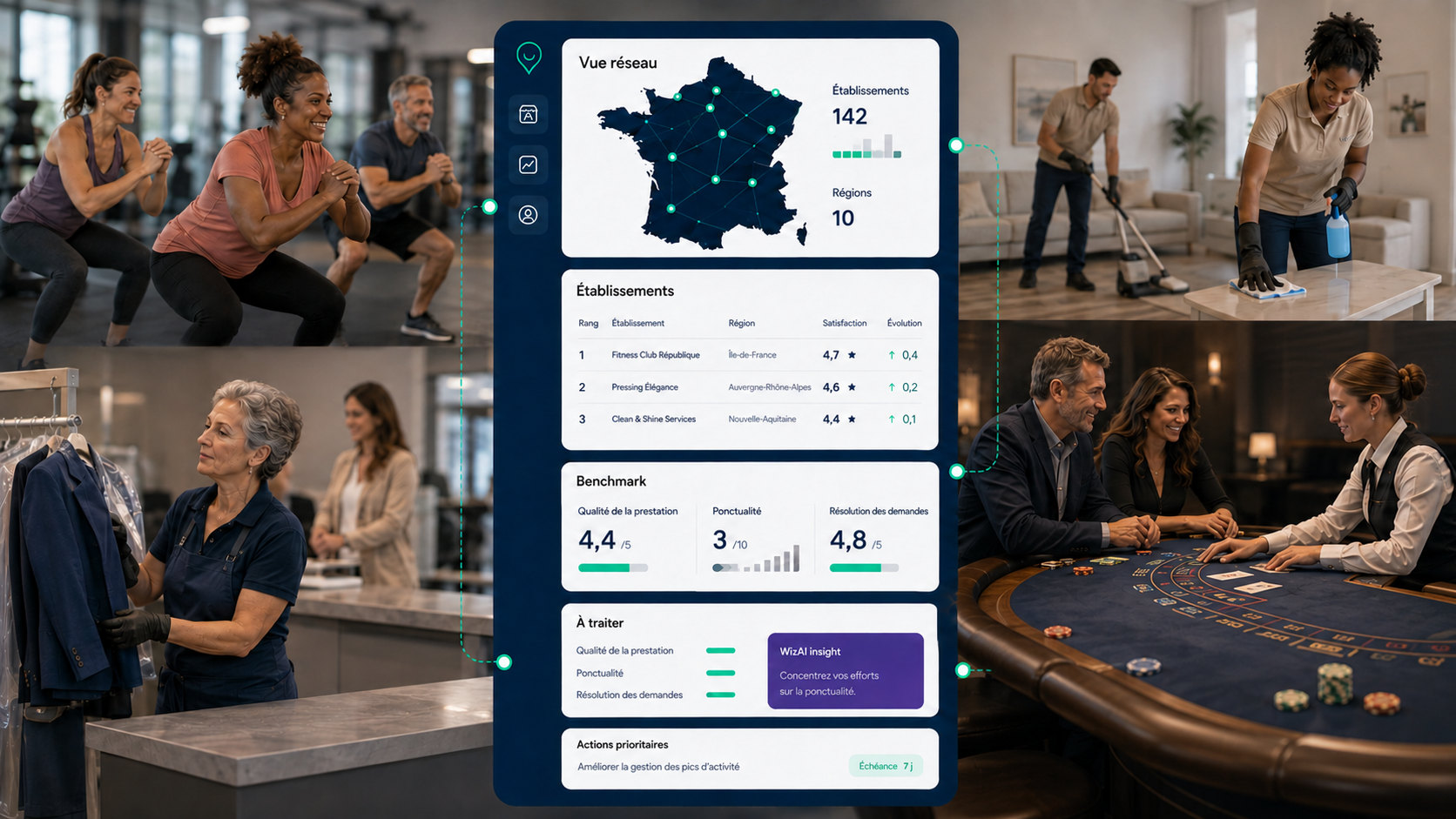
Ce qui se joue en magasin, lisible dans une seule interface

Salle de sport, pressing, prestation de ménage à domicile et espace de jeux reliés à l'interface Wizville de pilotage du réseau.
Illustration de l'interface Wizville — données fictives.
The method

From customer feedback to local action

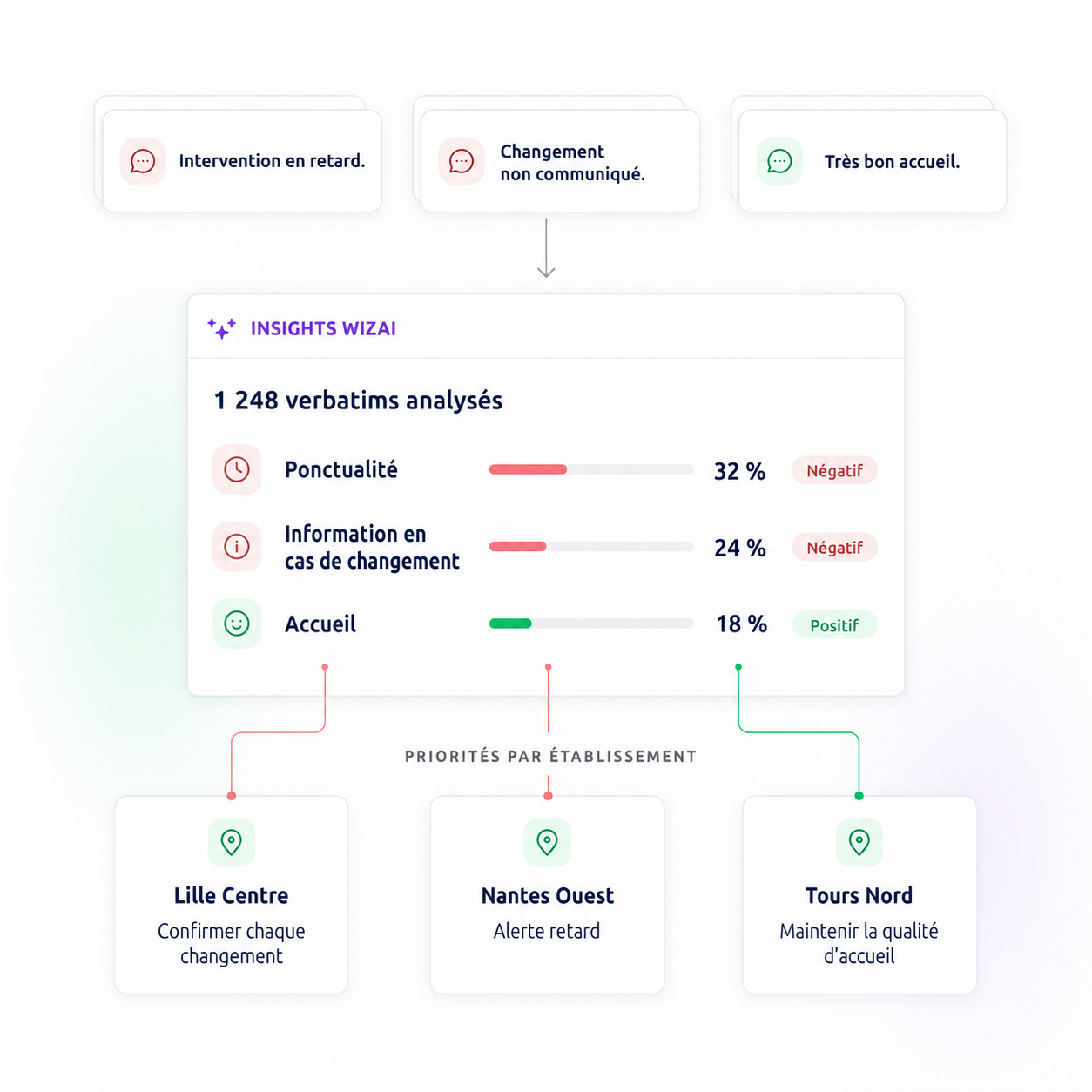
A score shows that something is happening. Context and verbatims say what to improve, where, and by which team.

  1. Step 1 Listen The right survey, at the right time, on the right channel — triggered by the event actually experienced: first visit, item collection, club sign-up, arrival at the spa, complaint closed, cancellation. Channel and length adapt to the audience, including people who do not respond online.
  2. Step 2 Understand Scores and verbatims brought together, then analysed by theme, stage, site, service, tenure and respondent role. Themes translate verbatims into operational causes — punctuality, welcome, cleanliness, equipment, handovers, scheduling, invoicing, dining, resolution — where an isolated score gives no direction.
  3. Step 3 Act Dissatisfaction triggers an alert according to your rules, the case is assigned to the right manager, the customer is called back, the action is documented then closed. Wizville speeds up detection, assignment and follow-up; the call-back and the resolution remain in your teams' hands.
  4. Result Strengthen trust Progress is measured where it happens: fewer breaks at transitions, complaints handled faster, a local reputation that becomes the visible trace of work in the field. This fourth step is not a feature — it is the consequence of the first three.

Ask less, but better

In services, the frequency of interactions makes over-solicitation a risk. A credible programme knows when to stay silent and keeps an eye on respondent representativeness.

Frequency-capping rules per person

A cap on requests per person and per period, deduplication across journeys, and the certainty that the same experience does not trigger two surveys.

Priority events

Systematic requests are reserved for rare or critical events: start-up, replacement, incident, complaint, exit. The rest is sampled.

Quiet windows

After a survey, during an open complaint, or during a sensitive period, no one is surveyed. Silence is part of the programme, not one of its limitations.

Representativeness tracked

Who responds, and who never responds? Tracking respondent representativeness avoids managing a network on the voice of a minority — and flags the audiences for whom the channels are not suitable.

Understand

The cause behind the score

A score says something is happening; it doesn't say what to fix. Operational themes give teams a more useful direction than an isolated score — and make it possible to distinguish what comes down to professional skill, organisation or information.

Themes that speak to the field

Punctuality, welcome, cleanliness, equipment, handovers, scheduling, invoicing, dining, resolution: words that a branch, club or site manager can turn into action the very next day.

Read by stage and by audience

The same theme does not mean the same thing depending on the stage of the journey, the site, tenure and the role of the person responding. An overall score without this context can lead to wrong decisions.

Breaks made visible

The main contribution is not collecting reviews: it is making visible the handovers that weaken the relationship, between two teams or two systems.

Proposed, then decided

Themes are proposed by the analysis and remain your teams' call. Wizville does not decide in their place and does not interpret any clinical, social or regulatory signal.

ChatGPT Image 23 août 2026, 18_01_56
Dissatisfaction to handle Network · last 7 days · illustrative example
"Care worker replaced twice this month, without anyone letting me know" Post-replacement survey · Rennes branch Branch manager Pris en charge Call back within 24 h
Item returned late with a disputed result Post-collection survey · Lyon Part-Dieu store Store management Nouveau Network escalation
Equipment unavailable at peak times, three weeks running Member pulse · Toulouse Nord club Club manager Pris en charge Within 48 h
Stay schedule communicated too late before arrival Start-of-stay survey · Spa resort Site coordination Traité Handled in 3 days
Illustrative example: ordinary dissatisfaction. A safety, dignity or abuse signal NEVER follows this circuit — it falls under a separate, immediate escalation procedure, defined with you.
Act

Dissatisfaction always has an owner

Negative feedback triggers an alert according to your rules, reaches the right team, leads to a call-back, then to a documented and closed action. This is what makes the management promise verifiable: it is not the score that changes things, it is the handling.

Serious signals — safety, dignity, suspected abuse — follow a separate, immediate escalation procedure, never the circuit of commercial dissatisfaction. Wizville makes no promise of automatic detection of abuse, medical risk or addiction.

Who receives the alert

Routing rules follow your organisation: store, branch, club, nursery, residence, site, region, brand or head office. Head office does not have to become a single response centre.

Who calls back, and how fast

An expected response time, an escalation case and a record of closure: governance is defined with you during roll-out, it is not hard-wired into the tool.

What we don't ask

A questionnaire does not collect any health or private-life details that are not necessary to handle the feedback. Sensitive topics are framed with your DPO before roll-out.

What the network learns from it

A poorly announced replacement, a missed deadline or unavailable equipment are lessons to share, not just cases to close. Head office sees the status and the trend.

Customer proof

Fitness Park turns every stage of the membership into a retention lever

Fitness Park listens to its members at sign-up, after a visit to the club and right through to cancellation. Clubs have a clear view of pain points and handle feedback as close to the field as possible, with a unified dashboard, monthly reports, centralised review management and a benchmark based on local and national Google ratings. Story covering 273 gyms and 221,000 customer reviews, with over 500 staff involved and an NPS improving continuously since 2021 — figures presented in the Wizville customer story. These results describe a specific programme: they are no guarantee for another network.


150 000+ reviews collected in ten months
73 % of reviews handled in under 72 hours
+0,13 pt on the average Google rating
Discover the Fitness Park story
ChatGPT Image 12 août 2026, 17_07_05
Network management

A shared vision, priorities tailored to each site

Head office sets the framework; each branch, club or site acts with the context that is its own. Managing consistency across a network does not mean erasing local realities — it means spotting what is systemic and supporting what is not.

A trend rather than a podium

The benchmark serves diagnosis: it compares a site to its own trajectory and to sites with a comparable profile. It should neither humiliate teams, nor confuse review volume, average rating, sentiment and regulatory quality.

Three levels of reading

Local responds and corrects quickly; regional supports sites and spreads good practice; national identifies common causes, sets the framework and measures progress.

Compare like with like

A city-centre dry cleaner, a home-care agency, a club in a retail park and a residence do not belong in a single ranking. Segmenting by business, format, area and journey avoids false gaps.

Energise, not just measure

Team brief, alert to handle, theme of the week, shared good practice, tracked action plan: results must leave the monthly committee and live in team rituals.

Satisfaction of a service network — 12 months Illustrative example
Satisfaction of a service network — 12 months
PeriodValue
Jan78
Feb77
Mar80
Apr82
May81
Jun84
Jul83
Aug85
Sep87
Oct88
Nov90
Dec91
SatisfactionNPSLocal public rating
Company-owned, franchised, agents, affiliates

Head office, region, site: each its own view

The programme is structured by brand, region, business, site and role. Each level receives a suitable view, rights and actions — the exact scope of access, alerts and integrations is defined during roll-out.

Head office and network management
Spot systemic problems by business, journey and audience, harmonise indicators without erasing specificities, and prioritise network programmes.
Region and field coordination
Identify the sites that need support, compare consistent scopes rather than rank, and circulate the practices that work.
Branch, club or site
See the feedback for your own scope, receive your alerts, call the customer back, reply to local reviews and measure your own progress.
Access and scopes are managed per employee — useful in a network where teams, franchisees and agents change.
Distinct voices, shared vision

Listen to several voices without confusing them

In services, the person who pays, the person who receives the service and the person who worries about a relative are not always the same — and do not live the same experience. Identifying the role of the person responding is not a methodological detail: it is what makes the measurement interpretable.

Parents and families

The question asked

Do the information you receive and your relationship with the team allow you to feel confident?

Who manages it Nursery management, regional management and quality
Example action

Rework the support given during settling-in or the regularity of handovers at an identified site. No young child is ever surveyed.

Resident, then relative

The question asked

Do you feel respected, informed and listened to in your daily life?

Who manages it Site management, quality and care coordination
Example action

Collect both voices separately, through accessible channels — including assisted or offline — and never substitute the relative's voice for the resident's when they are able to express themselves.

Customer, beneficiary and payer

The question asked

Does the visit match the agreed service plan, and were you informed of any change?

Who manages it Branch, network management and customer service
Example action

Segment by service, branch, tenure and respondent role: surveying only the payer when someone else receives the service distorts the reading.

Member, spa guest or visitor

The question asked

Does your experience match what you were promised at sign-up or booking?

Who manages it Club, site, marketing and loyalty
Example action

Distinguish each experience — welcome, activity, dining, accommodation, additional services — rather than aggregating a stay or a membership into a single score.

Satisfaction complements the quality approach; it replaces neither professional assessment nor the regulatory framework.

Listening more does not give the right to expose more

In trust-based services, discretion is part of the experience. Three principles frame the programme, and they are agreed with your quality and compliance teams and your DPO before roll-out.

Genuinely accessible channels

An elderly person, a family carer or a beneficiary who is not comfortable with digital tools must be able to respond: channel, length and format adapt to the audience, including assisted or offline versions. Tracking who never responds is part of the measurement.

Separate escalation for serious signals

Safety, dignity, suspected abuse: these signals follow a dedicated, immediate procedure, defined with you, and never the workflow of commercial dissatisfaction. Wizville makes no promise of automatic detection of this type of risk.

A complement, never a substitute

Wizville is not a compliance, inspection or diagnostic tool. It does not measure medical or educational quality, and a quality assessment result does not convert into a ranking of sites: contexts, dates and profiles are heterogeneous.

Google · Lyon Part-Dieu store · 3 h ago

"Really pleasant welcome, but my item wasn't ready on the date I was given and nobody could tell me when it would be. I had to come back a third time."

Written in the brand's tone · to be approved

Hello, thank you for your feedback, and thank you for highlighting the quality of the welcome. You are right on the essential point: a promised date must be kept, and if it cannot be, we must let you know and give you a new date. We have gone over this with the store team. Please contact us directly so that we can deal with your case.

Publish Edit Human approval before publication — no reply is published automatically, and a public reply never mentions personal information.
Responsible local online reputation

Reply fast, publicly with restraint, privately with precision

A survey and a public review do not express the same thing: one is tied to a moment, a site and sometimes a service; the other is spontaneous, public and influenced by the motivation to post. Wizville brings them together without artificially merging them.

A public reply never reveals a health condition, a dependency, a child's identity, the contents of a case file or a family situation — and need not confirm the service relationship when it is sensitive. Invitations to post a review remain neutral, sent to all eligible customers under a common rule, with no incentive and no selection based on satisfaction.

A consolidated view

Reviews from all your sites in a single feed, linked to the right site and the right themes, across the platforms and countries actually covered by the programme.

Clear responsibilities

Who replies, how fast, in what tone, and which cases go through a review before publication: the framework is set by head office, the reply stays local and in context.

Details go private

A good public reply acknowledges the feedback, stays empathetic and specific to the theme, then invites the person to continue the conversation on a private channel. The case is handled there, not on the listing.

Replying is not resolving

The best workflow links the review to an action in the field when the person can be identified and contacted again within an authorised framework. Handling status is tracked as an indicator in its own right.

Further proof

5àsec makes satisfaction a ritual for energising the network

5àsec gives its dry cleaners a local view of feedback while consolidating lessons at national and international level: real-time surveys after every visit, instant alerts in case of dissatisfaction, local and national views, centralised Google reviews, shared reports and dashboards. Figures presented in the Wizville customer story — to be revalidated before reuse in a campaign.

350+ dry cleaners involved
86 000+ reviews analysed
6 countries covered
8,7/10 average satisfaction
See the 5àsec story
ChatGPT Image 23 août 2026, 16_18_27
Frequently asked questions

Listening, multiple voices and local reviews: your questions

By choosing milestones in the journey rather than surveying after every interaction. Systematic requests are reserved for rare or critical events — start-up, replacement of a care worker, incident, complaint, cancellation — while everyday service life is listened to through spaced-out, sampled pulses. Three safeguards keep the programme sustainable: frequency-capping rules per person, deduplication across journeys, and quiet windows after a survey or during an open complaint. Tracking respondent representativeness then avoids managing the network on the voice of a minority.

By systematically identifying the role of the person responding, and collecting each voice separately. In a residence, a relative's voice is valuable but does not replace the resident's when they are able to express themselves. In a nursery, the respondent is the parent or legal guardian, and what they express is a parent's perception: no young child is surveyed. In home services, the customer, the beneficiary and the payer are not always the same person. Channels must remain accessible, including assisted or offline. Finally, satisfaction complements the quality approach: it replaces neither professional observation nor regulatory assessment.

A public reply acknowledges the feedback, stays empathetic and specific to the theme raised, then invites the person to continue the conversation on a private channel — without going into the details of the case. It never mentions a health condition, a dependency, a child's identity, the contents of a case file or a family situation, and need not confirm the service relationship when it is sensitive: nursery, residence, home-care service or spa resort. Delicate situations go through a review or approval before publication, and no reply is published automatically. The case itself is handled privately, with an owner, an action and a closure.

Consumer services

Give every local team the means to strengthen trust.

Discover how Wizville adapts listening, analysis and action to your network's journeys.

  • Listening triggered by the moments that matter, with controlled frequency-capping rules
  • Routing of dissatisfaction from head office to site, and follow-up through to closure
  • Distinct voices — customer, beneficiary, parent, resident, relative — in a shared vision

Request a demo

A demo tailored to your businesses, your audiences and your network organisation.