



Go behind the scenes and see our job openings on Welcome to the Jungle.
Welcome to the JungleAbonnez-vous à WizTips, notre newsletter.
S'abonner à WizTipsWizville brings together store satisfaction, omnichannel journeys, product reviews and local reputation to help specialty retail chains act, from head office to every store.

Specialty retailers, one shared demand for action

The management foundation is shared, but each sector has its own moments of truth and its own questionnaire. Select yours:
Seasonal availability, plant quality, advice and after-purchase follow-up: Wizville separates each pain point by season, sector and store to better support customer projects.
The right product, reliable stock, expert advice and suitable logistics: Wizville separates consumer and trade journeys, then checks announced availability against the actual experience.
From inspiration to after-sales, Wizville tracks every stage of long projects, pinpoints the origin of pain points and detects risks before installation or handover.
Wizville measures, without intrusive questions, personalisation and consistency across advice, product, store and e-commerce. It separates the product from the relationship and preserves brand identity.
Bargain or second life: Wizville puts unavailability in context, measures flow at peak times and harmonises the experience across a growing network, without sacrificing trust.
From choice to first use, Wizville separates advice, product and services, including workshop and repairs. Listening adapts to seasonal peaks.
Wizville makes every step of the business purchase reliable, from availability to invoicing. Management distinguishes user, buyer, decision-maker and administrator, and measures the relationship over time.
From the quick purchase to the multi-month project, specialty retail has to understand every journey while keeping the same promise, in every store, on every channel and at every step.
The customer moves from the web to the store, then to pickup, delivery or after-sales. They don't experience several channels, but a single journey to manage.
Quality, durability, assembly or compatibility: the product review measures fitness for use, and is managed differently from a store review.
Impulse purchases, advised purchases and long projects are not assessed with the same questionnaire, nor at the same moment. Personalisation depends more on the rhythm of the journey than on the product category.
Clearance, beauty, toys, home decor, everyday supplies
Did you find what you were looking for, and how did checkout go?
A wrong stock promise: the customer made the trip for nothing, and the pain point repeats store after store.
A very short survey, a signal sent to the store the same day, and the reliability of displayed stock checked on the product concerned.
Garden, pet, bedding, bikes, fragrance, technical DIY
Was your need understood before a product was suggested to you?
Advice that seemed credible in store, contradicted by actual use of the product — or perceived sales pressure.
Track relevance and clarity of explanation separately from adviser availability, and make verbatims a training topic rather than an individual score.
Kitchens, home fitting, pools, renovation, building materials and home projects
Does what was delivered and installed match what you were promised?
A promise made at the quote stage, not passed on to the team that delivers or installs: the customer, for their part, has only one counterpart — the retailer.
Listen at the useful milestones rather than once at the end, to locate the interface where the promise was lost and pick the file back up before handover.
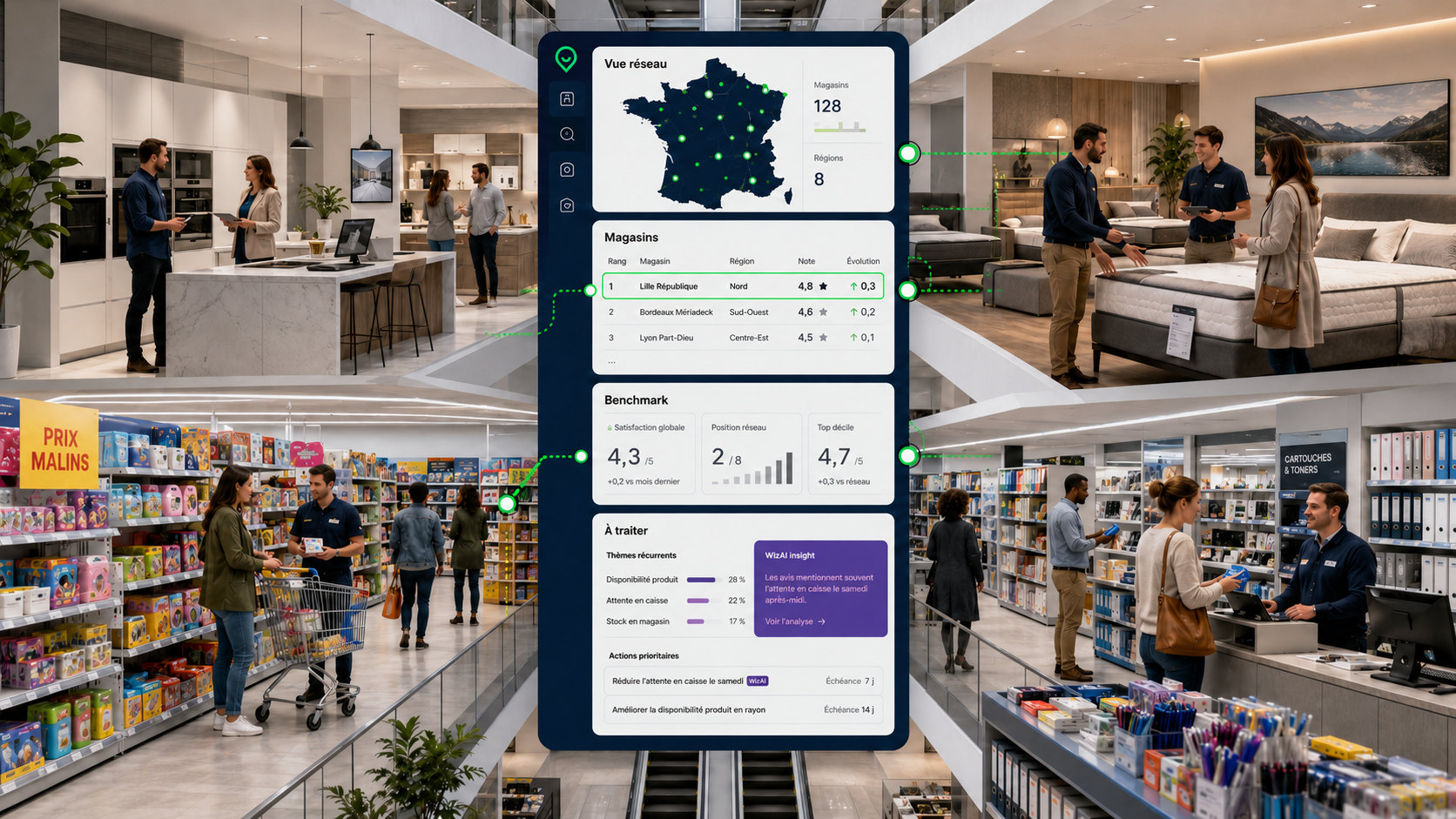
A customer experience platform goes beyond questionnaires: it brings together four sources and gives each level (head office, region, store and business teams) the reading it needs.
How did your visit go?
Fix the welcome, shelf availability or checkout organisation, in an identified store.
Did the journey keep its promise, from the website to installation?
Correct a poorly prepared pickup, a missed delivery slot or an after-sales team asking again for information already provided.
Does the product match its intended use?
Complete a product page, revise an assembly guide, report a recurring defect to the manufacturer.
What does the next customer looking for a store see?
Reply to reviews, track rating, volume and recency per location, and handle the recurring pain point.
A score tells you something is happening. Context and verbatims tell you what to improve, where, and by which team.
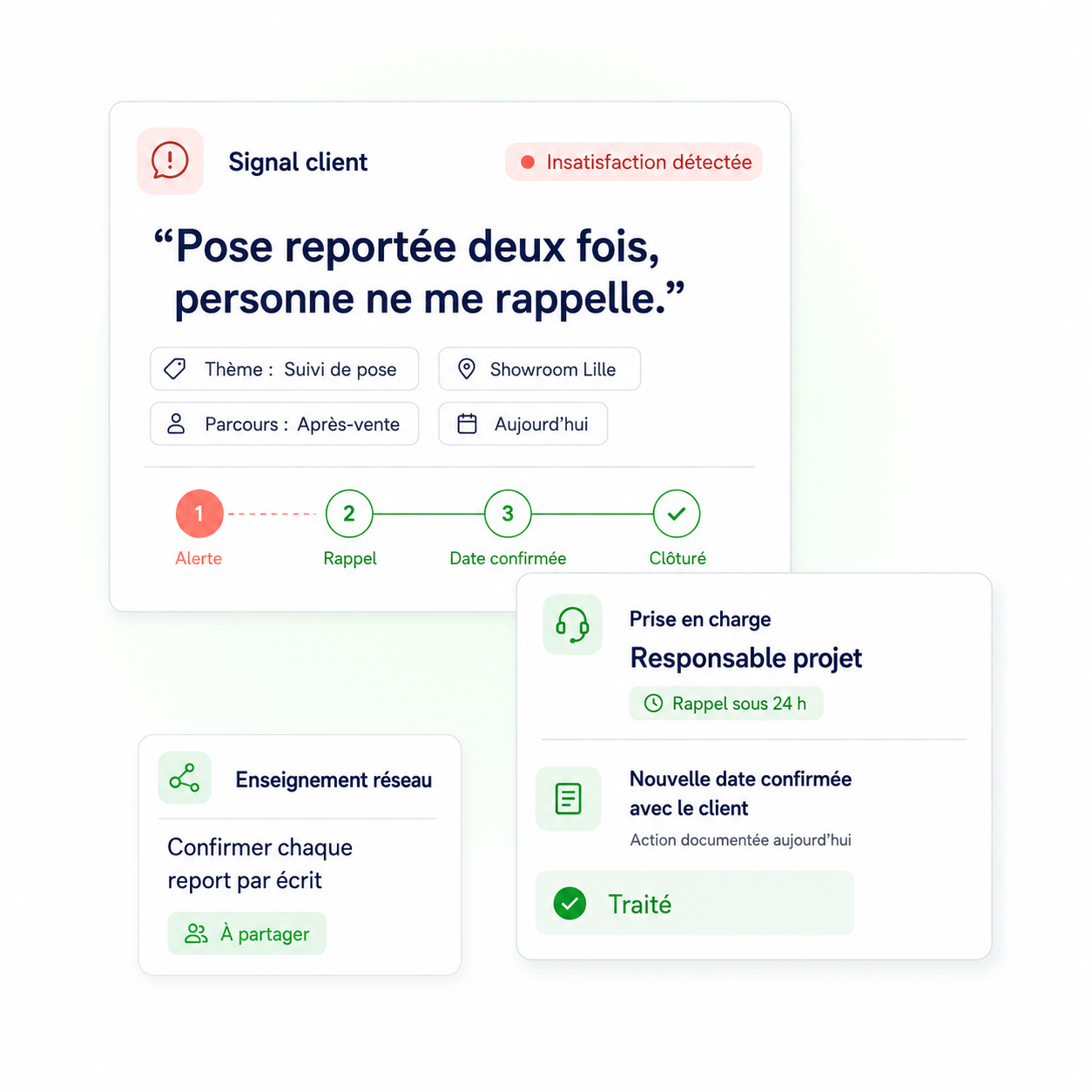
Every dissatisfaction triggers an alert, assigned and tracked through to closure. It is not the score that changes things, but how it is handled.
A verbatim becomes actionable when it is linked to a theme, a location, a journey and a date. Otherwise, the alert is just a notification.
Routing rules adapt to your organisation to assign each piece of feedback to the right team, without turning head office into a single response centre.
Deadlines, escalations and closures: governance is defined with you during roll-out, not imposed by the tool.
Postponed installation, unreliable stock or an unusable assembly guide: every incident becomes a shared lesson.
Kitchens, renovation, bedding or furniture involve several players, from the salesperson to the installer. Breakdowns often happen between them, without a final score revealing where they came from.
An appointment obtained late, or a visit prepared without the need being understood beforehand.
Ease of booking, showroom welcome and feeling of having been listened to on need and budget.
A project drawn up before the real constraints — space, use, budget — were set out.
Design quality, usefulness of the visualisation and credibility of the recommendation.
A quote whose scope, options and exclusions are not understood — trust is decided here.
Understanding of the quote, perceived transparency and trust after the appointment, measured before purchase.
A promise made at the sale, never passed on to the teams who will prepare, deliver and install.
Clarity of the confirmation, information received and consistency between what was promised and what was committed to.
Missed slot, incomplete or damaged product, deadline change not communicated.
Choice and respect of the slot, conformity and condition of the product, quality of information when something goes wrong.
Incorrect measurements, unfinished installation, site left untidy or fitter with no identified supervisor.
Professionalism of the fitter, cleanliness, handover explanation and installation completed to the end.
Snags noted at handover, then hard to get dealt with — the customer chases instead of the retailer.
Snags raised, time to take charge and perceived conformity of the delivered project.
An after-sales team asking again for information already provided, or a case changing hands with no history.
Effort asked of the customer, total time, resolution obtained and intention to recommend despite the incident.
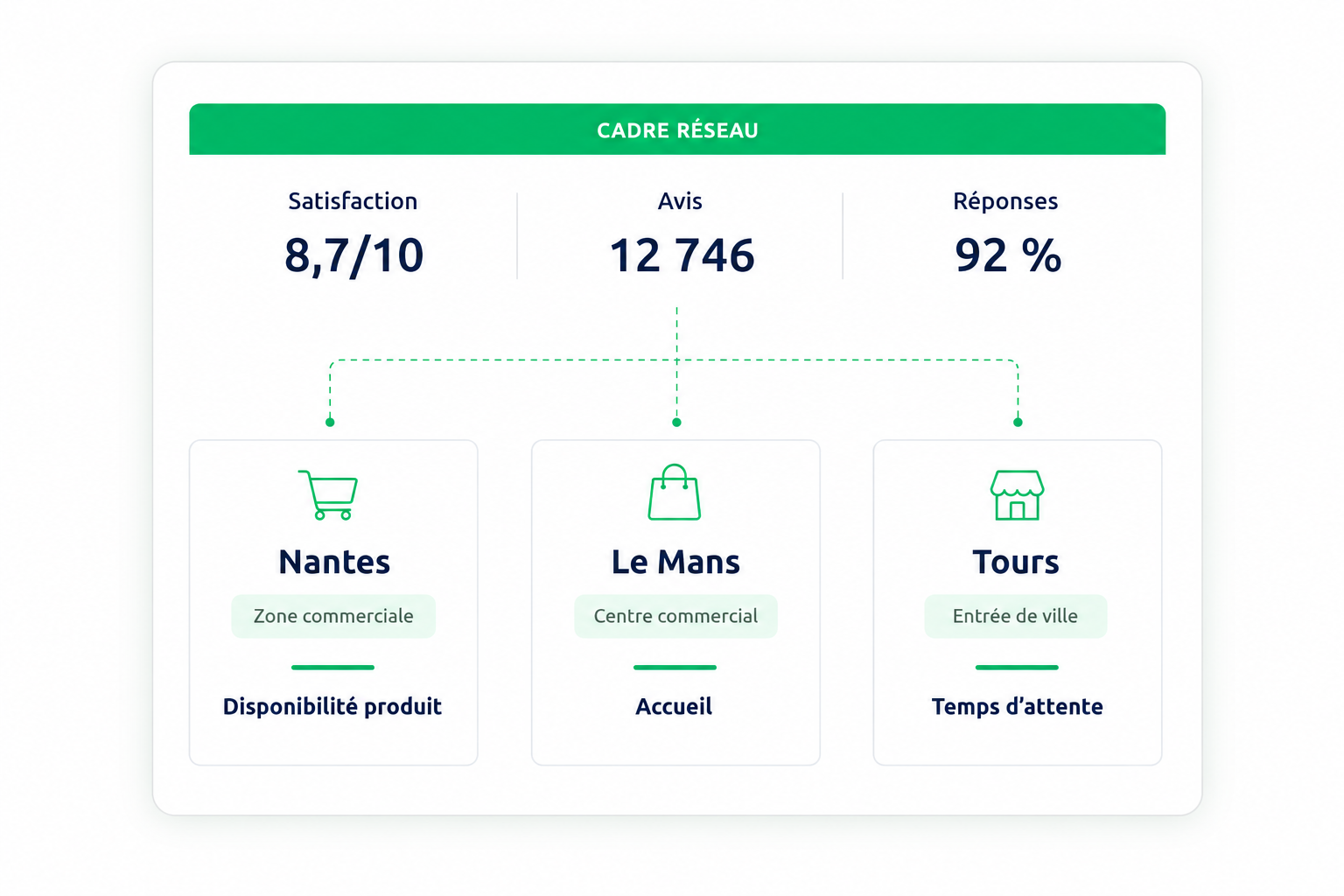
In multi-brand, multi-format groups, shared indicators ensure comparability, while tailored questions preserve local relevance.
Comparing similar formats, areas and footfall avoids false gaps.
A peak is compared with a peak, so as not to penalise the stores that absorb the most footfall.
The benchmark compares each store with its own trend and with similar sites to share best practices.
Briefs, alerts, priorities and action plans: results leave the monthly committee to drive team rituals.
The set-up adapts to every level of the organisation: group, brand, region, format, sector, store and role.
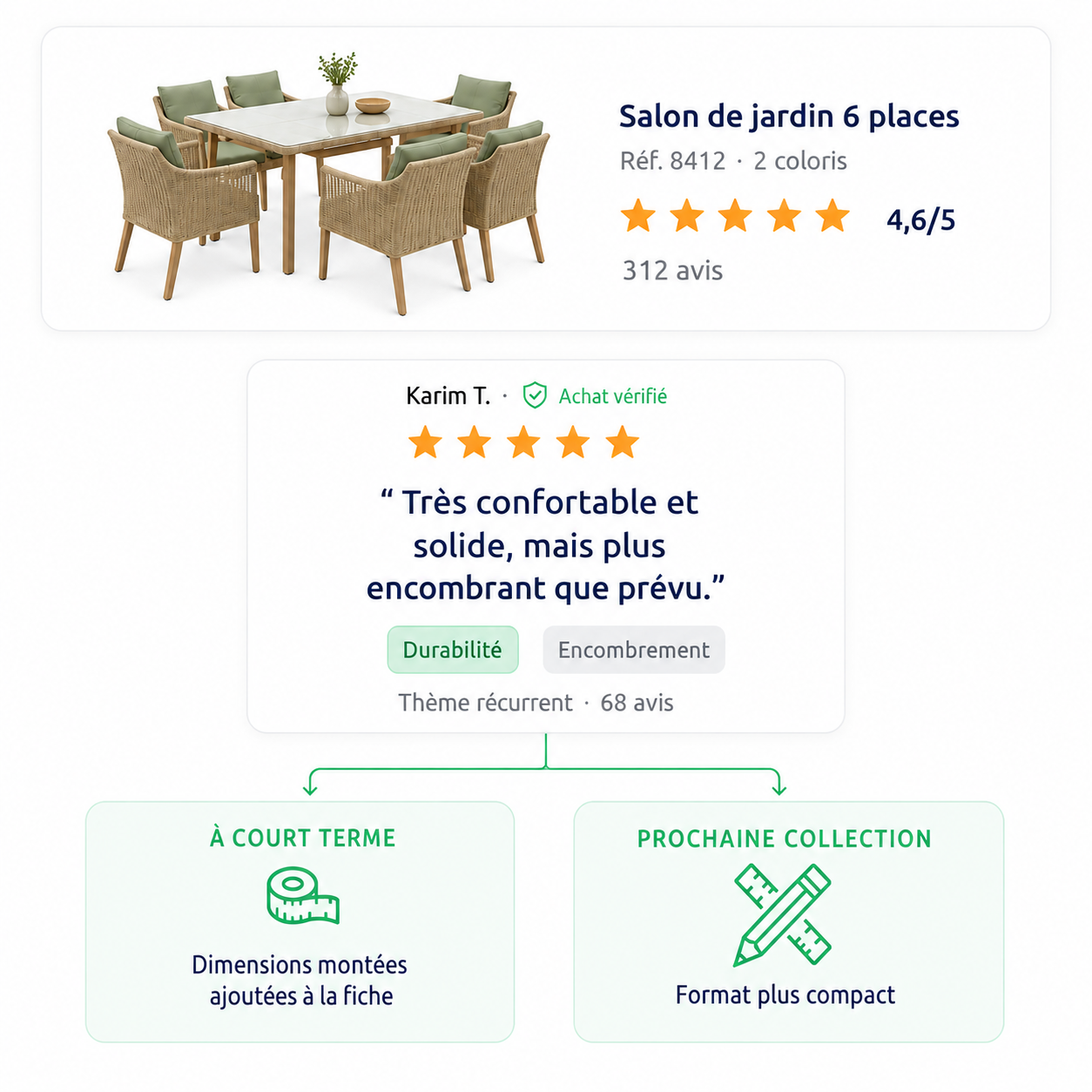
Beyond the stars, the product review reveals fitness for use and informs e-commerce, purchasing, quality, manufacturers and customer service.
Unsuited to recurring or made-to-measure orders, product reviews must be published with transparency about how they are checked, any incentives and purchase verification.
Rating, volume and recent reviews shown on each product page, collected after a verifiable purchase.
Assembly, dimensions, missing parts: when a problem repeats on one product, it becomes a quality signal.
Feedback from use guides variants, product pages and listings: it is product data as much as customer data.
Wizville collects customer perception of robustness, maintenance, repairability and the condition of second-hand products, without computing an index.
“Great advice on choosing the product, but the item was shown as available on the website and nowhere to be found at pickup. Nobody could tell me when it would be back.”
Hello, thank you for your feedback, and thank you for highlighting the quality of the advice you received in store. You are right on the essential point: an announced availability must be reliable, and if it is not, we owe you a solution and a date. We have gone over this with the store team and will call you back to offer an alternative.
For a committing purchase, the customer compares locally: rating, recent reviews, replies, lead times, installation and after-sales. Reputation is therefore managed location by location, not as a chain-wide average.
Invitations to leave a review are neutral, with no incentive and no selection based on satisfaction. Replying publicly does not solve the problem, but shows it is taken seriously.
Reviews from all your stores in a single feed, linked to the right location and the right themes, across the platforms and countries actually covered.
The four indicators that make a listing credible, tracked store by store rather than as a chain-wide average — with the distribution of ratings, not just the mean.
Who replies, how fast, in what tone, and which cases escalate: the framework is set by head office, the reply stays local and in context.
The best workflow links the review to an action in store when the customer can be identified and contacted again within an authorised framework. Handling status is tracked as an indicator in its own right.
Several brands, several systems, one management framework: the set-up covers post-purchase in store, e-commerce, product reviews and Google reviews, with dashboards tailored to local teams, regions and head office, dissatisfaction alerts and coordination rituals that feed store briefs. Each brand keeps its own questions and journeys, while remaining readable in a harmonised view. Figures presented in the Wizville case study, for 2024 — to be re-validated before reuse in a campaign.

Go further
The Wizville use cases specialty retail chains rely on.
By triggering appropriate listening after the main events — purchase, consultation, pickup, delivery, installation or after-sales — then analysing the results by journey, store, sector and theme. Frequency-capping and deduplication rules avoid surveying a customer several times about the same experience. The value does not come from the score alone: it comes from tracking the actions taken after the feedback.
By measuring the key stages rather than a single final score: appointment, quote, order, information, delivery, installation, handover and after-sales. An overall score does not say where the relationship broke down, whereas breakdowns almost always occur at the interfaces between teams — sales, warehouse, carrier, installer, customer service. Milestones are chosen according to the journey, so as not to over-solicit the customer.
A product review helps choose a product: it covers quality, durability, assembly, dimensions, actual appearance or compatibility, and is of interest to e-commerce, range and quality. A store review helps choose a store: it reflects welcome, expertise, availability, pickup, delivery and resolution, and is of interest to the store, the region and local marketing. They are complementary, but are not managed the same way — dashboards, responsibilities and response rules remain separate.
Discover how Wizville adapts listening, analysis and actions to the journeys of your brands and your stores.
A demo tailored to your sectors, your journeys and your network organisation.