


Go behind the scenes and see our job openings on Welcome to the Jungle.
Welcome to the JungleAbonnez-vous à WizTips, notre newsletter.
S'abonner à WizTipsWizville brings together customer feedback, public reviews and field signals to help automotive and mobility networks improve every journey, from head office to each site.

Networks that turn the voice of the customer into a tool for the field

Trust is the common foundation, but the proof expected is not the same: a vehicle inspection, a bodywork quote, a charging session and a bike handover cannot be measured with the same questionnaire. Select your business line.
Servicing, repairs, tyres and auto centres: getting the customer back on the road with work that is understood, approved, completed within the promised time and invoiced clearly. The management challenge is to separate how the welcome felt from technical trust, and to quickly spot a repair that did not fix the problem.
Carrying out an objective, punctual and clearly explained inspection, in a reassuring and independent setting. Management must measure how well things are explained without ever compromising the independence of the inspection, and separate dissatisfaction with the regulatory outcome from dissatisfaction with the service.
Helping the customer quickly find a compatible part or piece of equipment that is available and suited to their needs, whatever the channel. Management separates the product experience, advice and service, and links product reviews, local reviews and reasons for returns.
Reducing the uncertainty of an unwanted event by coordinating insurer, assessor, repairer and mobility solution through to a compliant vehicle return. The challenge is to measure a multi-party journey without attributing the wrong irritant to the wrong partner.
Fuel stations, energy and EV charging: enabling a simple, safe and reliable stop — finding the service, accessing the energy, paying without friction and getting help if something goes wrong. WizVille collects the perception of each step and matches it with the operational data available on your side — this feedback complements the technical monitoring of your equipment, it does not replace it.
Recommending the right mobility for the intended use, ensuring a proper handover and supporting the customer over time through the workshop and after-sales. Listening adapts to the customer's level of expertise and distinguishes between the sale, the handover, the workshop and everyday use.
The customer does not judge the technical result alone. They judge how easily they could book, understand, plan, stay informed and get back on the road with peace of mind. A job can be technically flawless yet leave a doubt: that doubt is what ends up in the reviews.
The service is asymmetric: the professional controls the diagnosis, the parts and the timings; the customer mostly knows their symptoms, their budget and their constraints. The perception of transparency matters as much as the work itself.
Repair order, quote for major work, approval of additional work, itemised invoice: so many information obligations, and so many moments of truth for trust.
Seven steps, seven opportunities to build or undermine trust.
No slot visible for several days, or a booking that requires a call back to be confirmed.
Ease of booking, lead time actually offered, clarity of what has been booked.
Waiting at the counter, symptom heard too quickly, vehicle taken in without the need being restated.
Quality of the reception and the feeling of having been heard on the real need.
Diagnosis delivered in technical language, without separating what is urgent from what can wait.
Clarity of the diagnosis and understanding of what is necessary, useful or can be postponed.
Additional work carried out without explicit approval, or a perceived gap between the quote and the invoice.
Clarity of the quote, approval obtained before the work, quoted price understood.
Silence while the vehicle is off the road: it is the customer who calls to find out where their vehicle is.
Updates received during the work, handling of setbacks and the promised deadline met.
Rushed vehicle return: invoice not explained, recommendations not prioritised, vehicle returned late.
Clarity of the invoice, explanations at handover, confidence in the result.
The problem returns, and the trip back to the workshop feels like starting the whole journey from scratch.
First-time fix, handling of a complaint, intention to return.
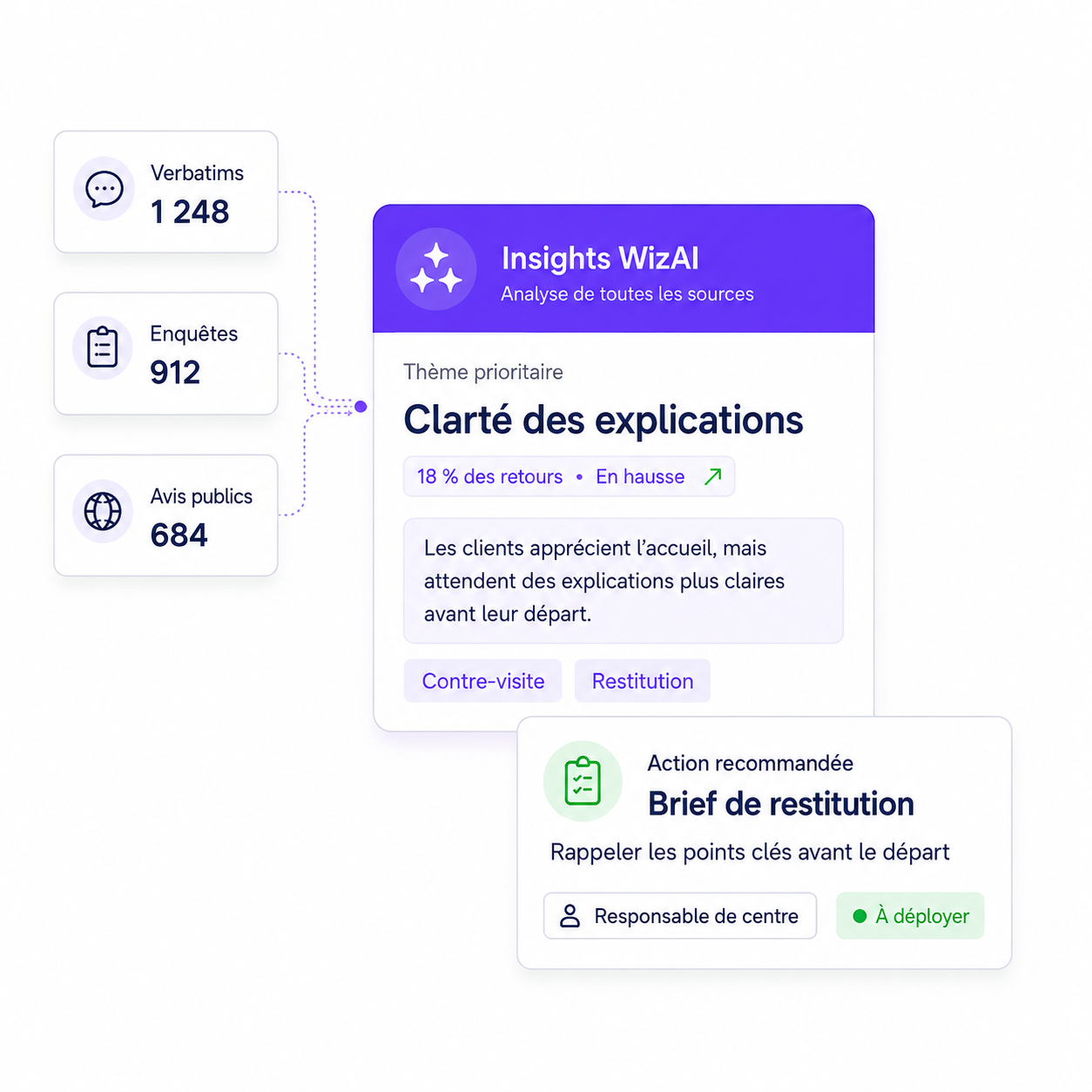
A score tells you something is happening. Context and verbatims tell you what to improve, where, and by which team.
Effective listening goes beyond courtesy. It measures understanding and trust at every step: diagnosis, quote, approval of the work, updates, invoice and result.
Fictional example: "The deadline was met, but I did not understand the difference between the quote and the invoice."
"Did you understand what needed repairing?" is not the same question as "Were you made welcome?" — and does not lead to the same action.
Tied to a theme, a site, a job and a date, a verbatim becomes actionable. It makes it possible to act, not just to comment.
The overall average barely moves, but some signals clearly deteriorate, such as understanding of the quote or updates while the vehicle is off the road.
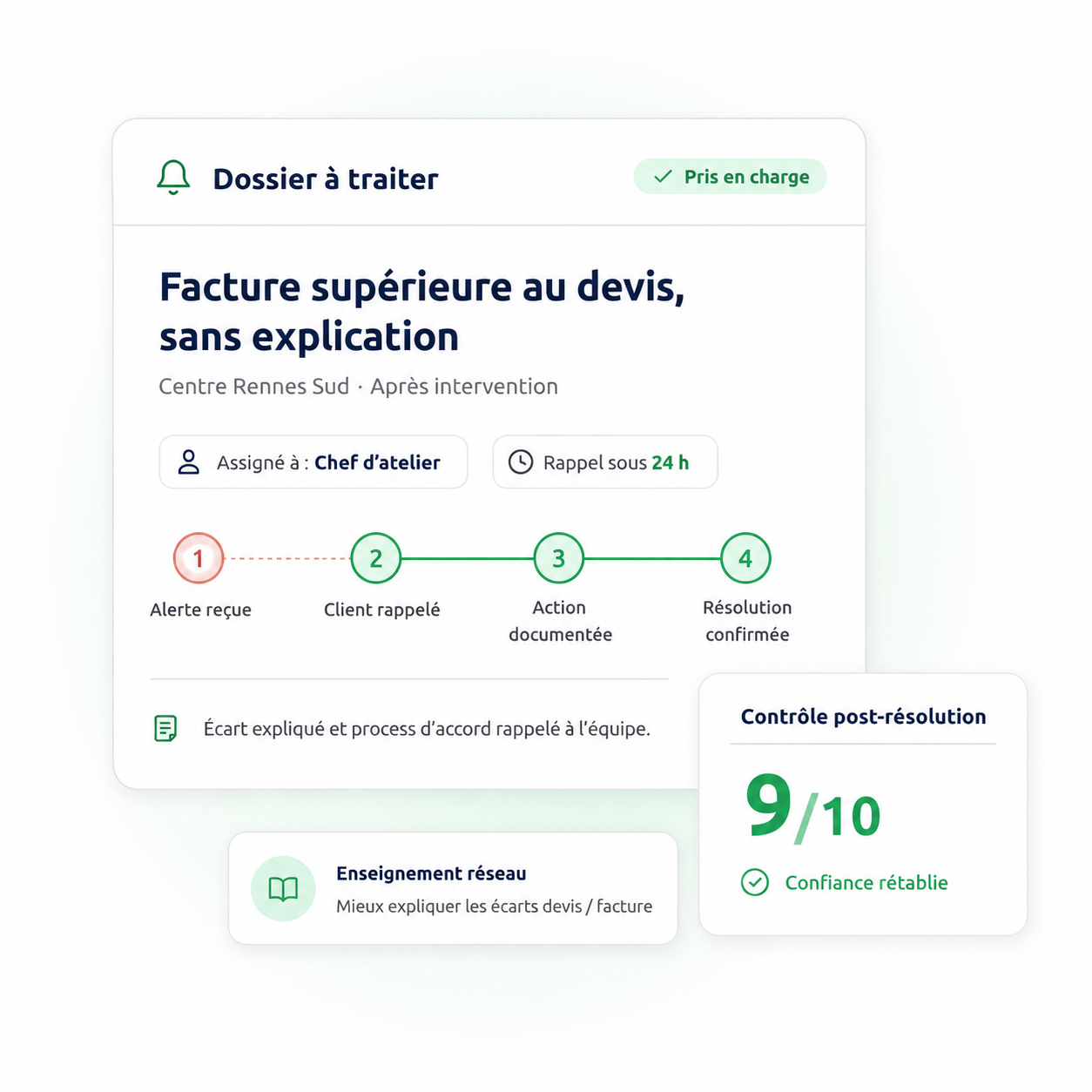
Negative feedback triggers an alert according to your rules, reaches the right team, leads to a call back, then to a documented and closed action. That is what makes the management promise verifiable: it is not the score that changes things, it is the handling.
Routing rules follow your organisation: centre, region, franchisee, member, customer service or after-sales — head office does not have to become a single response centre.
An expected response time, an escalation case and a record of closure: governance is defined with you during roll-out, it is not hard-coded in the tool.
An unresolved repair, a poorly explained quote or a vehicle kept far longer than planned are lessons to share with the rest of the network, not just cases to close.
A post-resolution survey, separate from the initial survey, checks that the customer's trust has been restored.
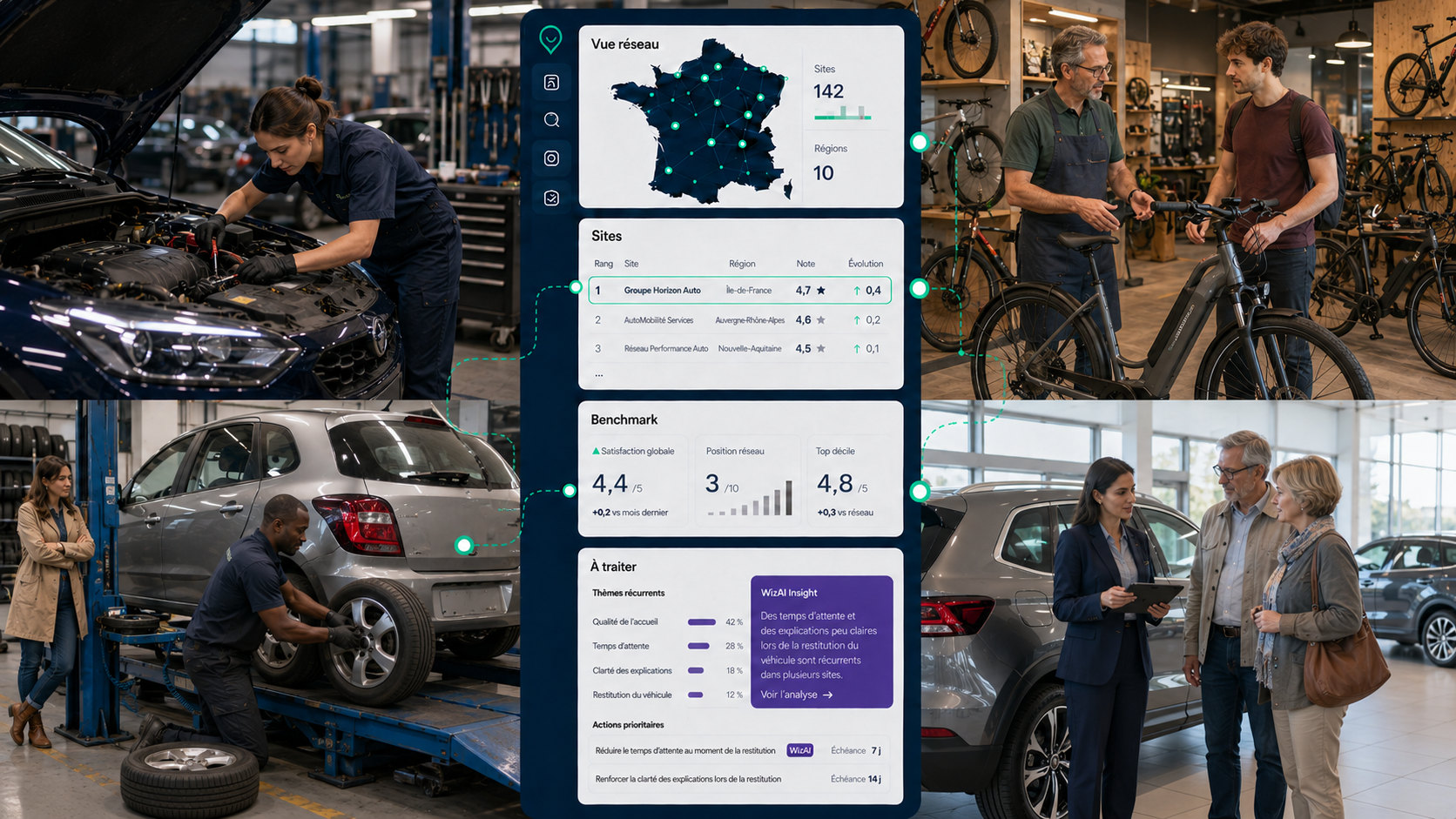
Automotive networks combine company-owned sites, franchisees, members, affiliates and partner repairers. Head office tracks trends and sets priorities, regions provide support, sites handle their feedback and reply. Each level needs a different reading of the same customer voice.
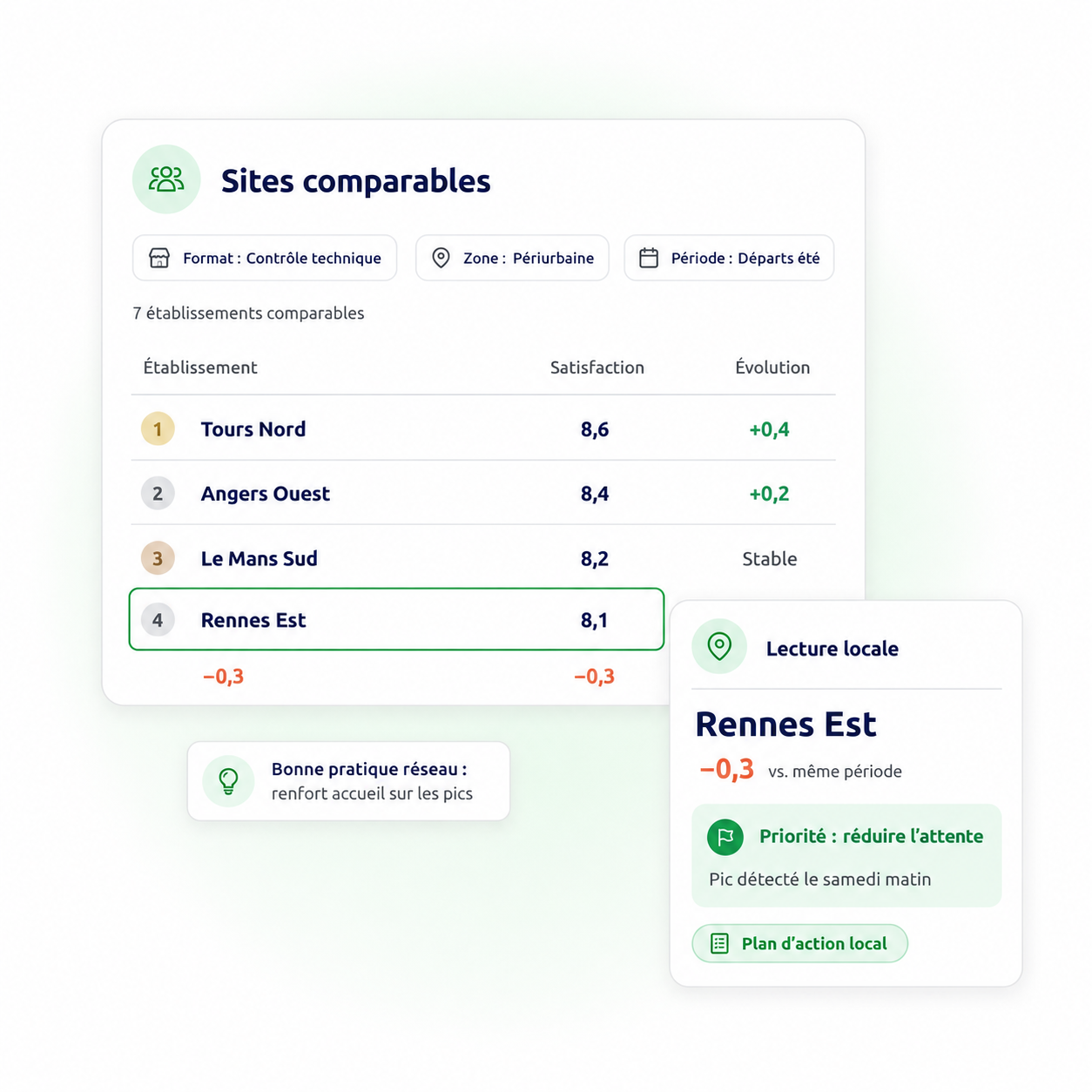
A busy urban centre, a rural inspection centre, a parts store and a motorway station do not belong in a single raw ranking: segmentation avoids false gaps and bad decisions.
The benchmark compares a site with its own trend, with sites of the same format or with equivalent areas. Gaps are used to target support and to spread good practice.
Holiday departures, change of season, switch to winter tyres, promotional campaigns: comparing a peak period with a normal period distorts the reading.
The set-up adapts to your organisation: brand, region, centre format, business line, site and role. Access, alerts and integrations are defined at roll-out to give everyone the information and responsibilities they need, without turning it into a way of policing the field.
Faced with a breakdown, an inspection or a tyre to replace, the customer searches locally. They compare proximity, availability, rating and recent reviews. Reputation is therefore managed site by site and area by area.
Invitations to leave a review are sent neutrally to all eligible customers, under a common rule, with no incentive and no selection by satisfaction. Replying publicly does not solve the problem, but shows it is being taken seriously.
Reviews from all your sites in a single feed, attached to the right site and the right themes, across the platforms and countries you actually cover.
Lack of transparency, work not understood, quote/invoice gap, delays, persistent fault, site impossible to reach: what is rising locally and across the network.
Who replies, how quickly, in what tone, and which cases are escalated: the framework is set by head office, the reply stays local and in context.
The four indicators that make a listing credible, tracked site by site rather than as a brand average.
A personalised, automated listening programme rolled out across the centres, a clear reading of the areas for improvement and a local reputation tracked centre by centre: vehicle inspection comes down to clear explanations and punctuality, and that is exactly what the programme measures. Figures published in the WizVille customer story — to be re-dated before reuse in a campaign.
Going further
The WizVille use cases automotive and mobility networks rely on.
By triggering a survey after the events actually experienced — a job, a vehicle inspection, a parts purchase, a vehicle return after bodywork, a charging session, a workshop visit — then segmenting the results by journey, business line, site and reason. Contact-frequency rules avoid sending several surveys for the same experience, and a separate survey can be triggered once a complaint has been resolved. The value comes from following up on actions, not from the score alone.
Clarity of the diagnosis and the quote, approval obtained for the work, updates received while the vehicle is off the road, deadline met, perceived quality, understanding of the invoice, first-time fix and intention to return. To be tracked separately from overall satisfaction: a technically correct job can leave a doubt about the price or the result, and that doubt is what later ends up in public reviews.
Yes, by collecting feedback on finding the station, access, starting the session, price clarity, payment, perceived speed and assistance in case of failure. This feedback is then matched with the operational data available on your side. It complements the technical monitoring of your equipment; it does not replace it and does not measure charger availability.
Find out how WizVille can adapt listening, action in the field and online reputation management to your business lines and your organisation.
A demo tailored to your business lines, your journeys and your network organisation.