Remove the friction points along the journey, reassure with verified reviews, measure the effect on your sales: more customers complete the purchase, in store and online.
They link their customers' experience to their sales results
Conversion isn't decided at the checkout alone
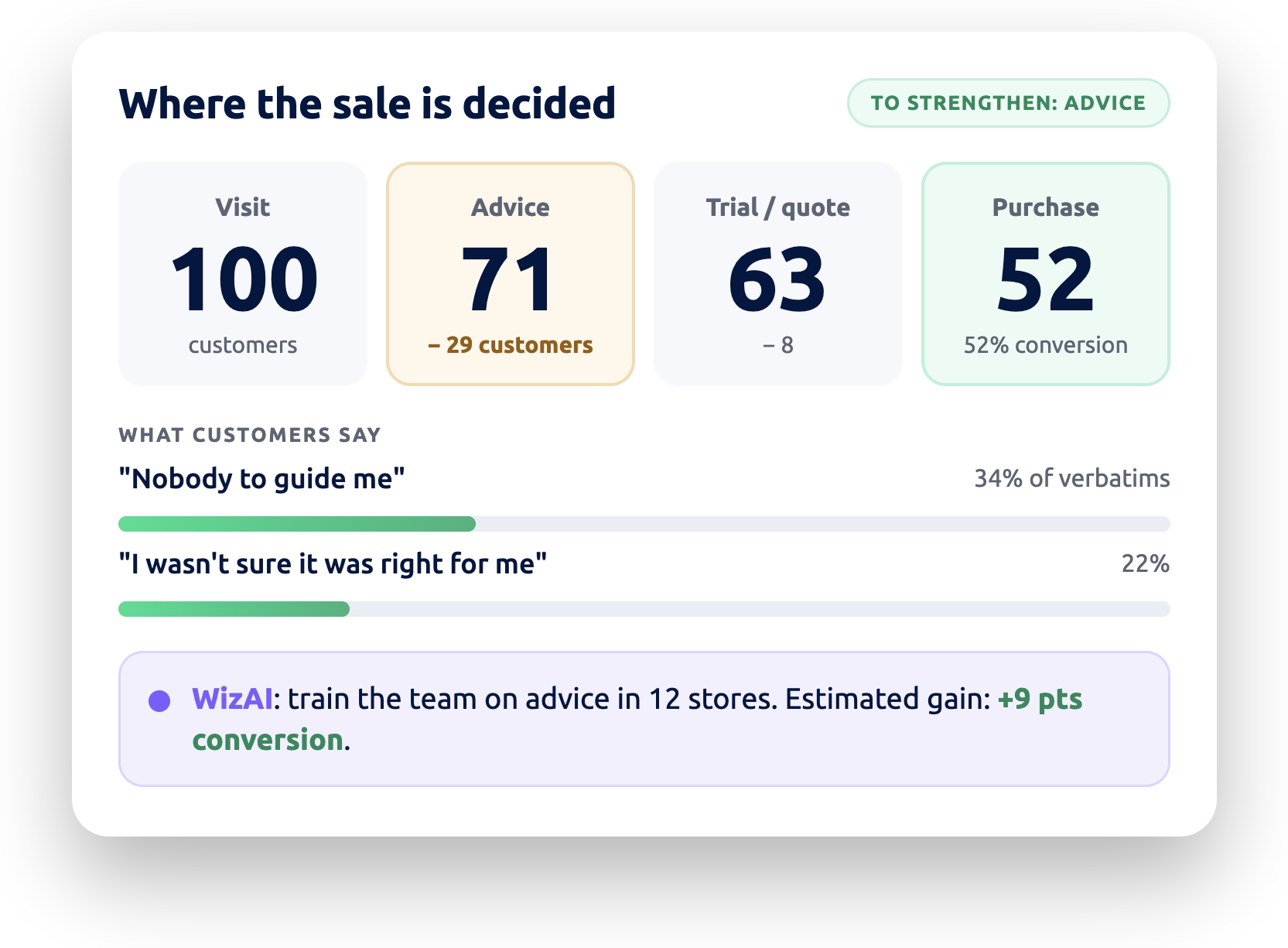
It is built throughout the journey, at every moment when the customer looks for a reason to move forward or walk away. The decision is rarely lost on price alone.
One journey, several tipping points
Research
Comparison
Visit or first contact
Advice and trial
Quote or basket
Decision
Buying, booking, making an appointment, accepting a quote, signing up: the steps change name depending on your business, not the mechanics. At each one, an unresolved doubt can stop the decision.
Missing information
Composition, compatibility, lead time, terms: what goes unsaid becomes a reason to postpone.
Doubt about the product
Size, material, real-life use, durability: without an answer, the customer would rather not risk a mistake.
Reviews too rare or not credible enough
Too few reviews, too old, or impossible to tie to a real purchase: the proof no longer reassures.
Uncertain availability
A product perceived as unavailable, a slot that can't be found: the customer goes elsewhere rather than wait.
Inadequate welcome or advice
Nobody to point the way, a vague answer: the doubt remains and the sale doesn't happen.
Too long a wait
In the aisles, at the checkout, on the phone: waiting turns intent into abandonment.
A complex quote or appointment process
Too many steps, too many delays, too many grey areas: the project stops before signature.
A gap between promise and reality
What is announced online doesn't match what the customer finds in store: trust breaks down.
02 — Prioritise
Not all friction points cost the same
The most-cited friction point isn't always the one that makes customers walk away. To tell the two apart, Wizville surveys your customers at decisive moments, analyses what they write, and separates those who bought from those who left.
Questionnaires at decisive steps
After a visit, a trial, a quote or a delivery: the question is asked when the answer makes sense.
Verbatims analysed, not just counted
Topics and tone are extracted automatically, then made readable for the teams concerned.
Alerts on weak signals
A topic on the rise at one site surfaces before it shows up in the sales figures.
Verbatim — customer who left without buying
“I wanted to change my bedding and nobody could tell me what would suit my back. I wasn't going to spend €1,500 at random, so I left with nothing.”
Lyon Ouest store · post-visit questionnaire · 3 h ago
Topics detected
Quality of adviceNegative
Help choosing a productNegative
WelcomePositive
WizAI summary · post-visit feedback
Among visitors who left without buying: quality of advice is the most frequently cited topic, far ahead of waiting time. Illustrative example.
Focus effort where it changes the decision
Cross what matters to your customers with what you deliver today: frequent but non-decisive friction points separate themselves from those that actually cause customers to walk away.
What matters to your customers, what you deliver todayIllustrative example
Current performance
Good level, not decisiveStrengths to preserveKeep an eye on, no rushPriority zoneQuality of adviceClarity of the quoteProduct availabilityWaiting timeWelcomeCleanliness
Importance in the purchase decision
What matters to your customers, what you deliver today
Topic
Importance in the purchase decision
Current performance
Quality of advice
88/100
30/100
Clarity of the quote
70/100
42/100
Product availability
64/100
76/100
Waiting time
40/100
34/100
Welcome
54/100
88/100
Cleanliness
18/100
80/100
WizAI recommendation
Quality of advice is the topic most closely linked to purchase, and the one where you lag furthest behind. That's where effort is most likely to show in your sales.
How to read the matrix
Bottom right: very important to the customer, unsatisfactory on your side. This is what actually drives abandonment.
Top right: what makes customers choose you. To preserve, to publicise and to roll out elsewhere in the network.
Left: very real friction points, but ones that weigh little on the purchase decision. They don't deserve the first euro invested.
A topic that is oddly placed or unstable deserves closer analysis before committing to an action plan.
Position built from your customer feedback and your sales data. Wizville identifies relationships and determining factors; it does not attribute a sale to a single review.
Pleated midi dress · ref. 4821Product page
The question the next buyer is asking
“Does it run small?”
What those who bought it say
Runs smallTrue to sizeRuns large
Runs slightly small
58% recommend going up a size.
128 verified reviews · tied to a confirmed purchase
02 — Remove the doubt
A friction point removed is a purchase triggered
Once friction points are ranked, they still have to be removed at the moment they block. A useful review doesn't simply say the customer is satisfied: it answers the question the next buyer is asking.
The concrete information that decides
The cut, the size worn, comfort, how it holds up over time, ease of assembly: what only customers can tell you.
Tied to the right product reference
One review per product and per variant, not an overall brand score that removes no hesitation.
Verified reviews, and verifiable ones
Each review is tied to an identifiable purchase or visit. Claiming your reviews come from genuine buyers means controlling where they come from.
03 — Align
An action plan per site, not a national plan
Head office sets the course, but the friction point to handle isn't the same in Nantes and in Lyon. Wizville turns each site's priorities into a concrete plan — actions, one owner per action, and progress everyone can see.
Priorities calculated, not guessed
Each site receives the two or three topics that weigh most on ITS conversion, drawn from its own customer feedback.
Concrete actions
Not a general recommendation, but a specific move: reopen a checkout at midday, train staff in bedding advice, rework the quote template.
One owner per action
Each action carries a name and a deadline. What is assigned to nobody doesn't move forward.
Execution tracked, not declared
Head office sees what's done, what's dragging and where support is missing — without chasing site by site.
Action plan · Lyon OuestHelp choosing a product
5 This quarter's actions3 / 5 actions completed
Train the team in bedding advice
Display choice guides in the aisles
Assign a lead sales advisor on Saturdays
Rework the product sheets for premium ranges
Measure again after 6 weeks
Owner
Store manager, due end of quarter.
Proposed by WizAI
Topic most closely linked to conversion at this site.
What gets flagged, and to whomNetwork · last 7 days
Advice judged insufficient, 4 comments in 48 hLyon Ouest · post-visitStore managerPris en chargewithin 24 h
Checkout queues on Saturday lunchtimeNantes Nord · post-visitWest regional managerNouveauwithin 3 days
Colour perceived as different from the visualsE-commerce · product reviewProduct contentTraitéthis week
Illustrative example. Routing follows your actual organisation: each signal goes to the level able to act, with an expected turnaround and a status visible to head office.
03 — Align
The right action, to the right person, at the right time
Aligning service quality doesn't mean sending the same instruction to everyone. It means making sure each signal reaches the level able to act — and knowing afterwards whether it was handled.
Routing aligned with your organisation
Store, region, head office, e-commerce, product content: each receives what concerns them, and nothing else.
An expected handling time
A signal without a deadline becomes one more notification. Each alert carries its own.
A status, not a declaration
New, in progress, resolved: progress is read in the same place by the site and by head office.
Best practices rolled out
What works at one site becomes an action proposed to the others, instead of remaining an isolated case.
04 — By use case
The same mechanism, three different settings
In store, on a quote or online, the moment that blocks isn't the same — and isn't removed with the same proof. The reasoning, however, doesn't change.
In store
The moment that blocks
The customer hesitates and nobody comes. Advice is missing at the precise moment of choice, or the wait gets the better of the intent.
What Wizville puts up against itPost-visit listening, friction points ranked store by store, and an action plan on staff availability and quality of advice.
What moves next
In-store conversion rate, average basket, add-on purchases.
On a quote
The moment that blocks
The project drags on: too many steps, a quote that's hard to read, a delay with no news. The customer doesn't say no, they just stop replying.
What Wizville puts up against itListening after the appointment and then after the quote is sent, to see where the journey breaks and what remains unclear.
What moves next
Quote acceptance rate, time to decision, drop-offs along the journey.
Online purchase
The moment that blocks
The product doubt isn't removed: size, material, real-life use. Without an answer, the basket stays open and the customer leaves.
What Wizville puts up against itReviews tied to the right reference and the right variant, usage information passed to content teams, verified proof displayed on the product page.
What moves next
Add-to-basket, conversion rate, return rate.
Three settings, one line of reasoning: identify what blocks, rank it by impact, remove it with the expected proof, then measure the behaviour that follows.
05 — Measure
Measure the value created by a better experience
NPS and average rating don't say what the experience produced. Each friction point removed shows up in a behaviour, then in a financial result.
What changes in the experienceWhat the customer doesWhat it produces
What changes in the experienceMore relevant advice
What the customer doesMore purchase decisions
What it producesHigher conversion
What changes in the experienceShorter waits
What the customer doesFewer drop-offs
What it producesRevenue preserved
What changes in the experienceA clearer quote
What the customer doesMore quotes accepted
What it producesBetter conversion rate
What changes in the experienceA more available team
What the customer doesMore add-on purchases
What it producesHigher average basket
Every link in the chain is measurable: Wizville sets your experience indicators against your sales indicators, site by site. No causality is claimed without data to back it up.
Discover what really turns experience into purchases
Wizville helps you identify the moments that make your customers move forward or walk away, then focus your actions on those that generate the most value.
A reading of the moments when your customers hesitate or walk away
Your friction points ranked by real impact on the purchase decision
An action plan per site, with its owners and its follow-up