







As generative AI becomes widespread, a brand's visibility is no longer decided only in search engine results pages. It now also depends on being cited, quoted or recommended in the answers produced by AI assistants.
Large language models (LLMs) rely on a cluster of signals that goes beyond Google's traditional criteria. In this context, the most relevant content is clear, structured and easy to verify.
Trustville verified customer reviews meet these criteria. They are based on proof of purchase, published by an independent third party and presented in a machine-readable format. That is exactly what makes them useful material for a GEO strategy.
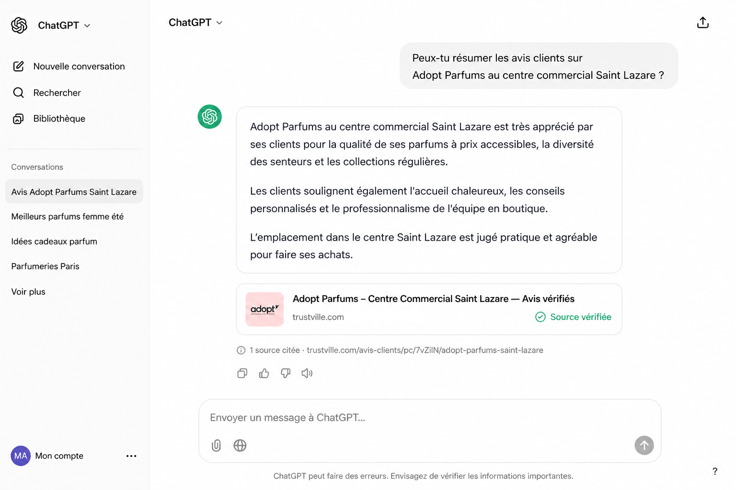
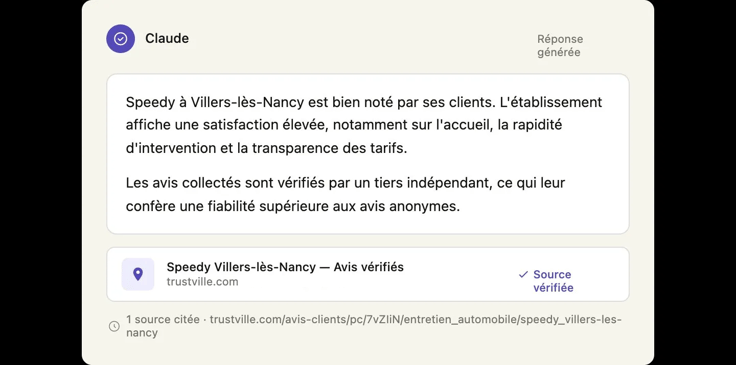
What does this look like in practice? Here is what two AI assistants answer today when a consumer asks about a retailer that is a Trustville member.
On ChatGPT, the retailer's Trustville page appears as a verified source directly in the generated answer.
On Claude, the mechanism is the same: the AI summarises the reviews and cites Trustville as the primary reference, without the user having to search for it.
This article explains how Trustville verified reviews can become a GEO asset for your brand.
What exactly is GEO?
GEO (generative engine optimisation) is the set of methods that aim to improve the visibility of a brand or a piece of content in the answers produced by generative engines and AI assistants.
GEO extends SEO but changes the target: the aim is no longer only to rank a page, but to make information citable by generative engines.
For brands, the challenge is therefore to appear as a reliable source on a specific topic.
In practice, GEO rests on three pillars:
- Semantic clarity: content must be explicit, structured and unambiguous so that a language model can understand it easily.
- Verifiable authority: AI favours content backed by facts, identifiable sources and reliability signals close to the E-E-A-T criteria.
- Structured data, in formats such as Schema.org or JSON-LD, which makes information more machine-readable and easier to extract.
For brands, GEO adds a further layer, centred on whether content can be used in generated answers.
The content most easily reused is content that gives a clear, documented and directly usable answer. That is why verified customer reviews, when they are well structured and linked to proof of purchase, play a valuable role in a GEO strategy.
Why does AI favour verifiable content?
AI favours verifiable content because generative engines look for information they can cite with confidence.
To produce a relevant answer, an AI has to weigh several sources, estimate their reliability and keep those that offer the strongest proof.
The less ambiguous a piece of content is, the easier it is to reuse. This is what gives verified reviews a particular advantage.
This logic echoes the E-E-A-T criteria (experience, expertise, authoritativeness and trustworthiness) that search engines, Google first among them, have applied for a long time. What changes is the scale: LLMs often draw on only a handful of sources, sometimes just one, to answer.
Verified customer reviews fit this credibility logic perfectly. When a review is linked to proof of purchase, time-stamped, attributed to an identifiable source and presented in a clear structure, it becomes trustworthy and usable by a generative engine.
AI also favours verifiable content because it aims to produce answers that look stable over time. Content based on sourced data, readable markup and objective elements is less fragile than opinion. This is even more true when the source publishes fresh, continuous data, because recency strengthens the perception of reliability and relevance.
How does Trustville create a trust signal that AI can use?
Trustville turns a review into authoritative data: each review is linked to a transaction, structured and published by an independent third party.
The first key factor is verification by proof of purchase. Unlike reviews that are more anonymous or harder to link to a real transaction, Trustville relies on a framework that ties the opinion to an identifiable purchase. This link makes the information more solid and increases its chances of being reused.
The second factor is data structure. When a page displays an aggregate rating, a review count, individual reviews, dates and authors in a machine-readable format, it becomes much easier to extract and summarise. This is what generative engines look for: clear, stable blocks of information that can be used without heavy interpretation.
The third factor is the role of trusted third party. The platform positions itself as independent. For an AI as for a user, the fact that the brand does not control the publication of reviews strengthens the credibility of the system.
Finally, the fourth factor is continuous freshness. A steady flow of new reviews signals a living source that is constantly updated, not a static page. For GEO, this matters because generative engines favour sources that reflect the current state of a reputation rather than an outdated snapshot.
In short, the chain works like this:
- The Trustville member retailer shares its transaction feed; review collection is delegated to Trustville, and every review is verified by proof of purchase.
- Trustville acts as a layer of verifiable data: aggregate rating and review count in Schema.org JSON-LD (AggregateRating), individual reviews with text, date and author (Review entities), and a canonical entity page for each location.
- AI engines read this data through crawling, indexing and real-time retrieval: ChatGPT search, Perplexity, Google AI Overviews and Microsoft Copilot.
- The result for the retailer: being named directly in AI answers, aggregated reviews read by the LLM, stars visible in search results, a stronger entity in the knowledge graph, and isolated negative reviews outweighed by a larger volume of verified ones.
How do verified reviews, Schema.org and entity pages work together?
For GEO, what matters is less the number of reviews than how they are integrated into a format that engines can interpret without difficulty.
Verified reviews gain GEO value when they sit on a page designed as a true entity page. An entity page brings together the brand's identity, its rating, its review count and the elements that let engines identify it as a credible reference.
Schema.org plays a central role here. By marking up data with types such as AggregateRating, Review, Organization or LocalBusiness, you make information machine-readable far more reliably.
| AI criterion | Forum reviews | Google reviews | Trustville reviews |
|---|---|---|---|
| Factual | ✗ Variable | ~ Partial | ✓ Rating + volume |
| Verifiable | ✗ Anonymous | ✗ No proof of purchase | ✓ Proof of purchase |
| Structured (JSON-LD) | ✗ None | ~ Limited | ✓ Native Schema.org |
| Independent third party | ✗ None | ✗ Self-hosted | ✓ Independent third party |
| Status for an LLM | Unqualified | Semi-open | Primary source |
For an AI, this markup reduces ambiguity. It knows where to find the rating, the number of reviews, the authors, the dates and the content of customer feedback.
Verified reviews add further value because they bring a layer of proof. When a review is linked to a real transaction, time-stamped and moderated by an independent third party, the content gains technical as well as editorial credibility.
Another important point is the combination of volume, freshness and structure. It is this combination that increases the chances of being reused as a reliable source.
How do GEO signals also improve visibility on Google?
GEO signals do not only serve AI: they also improve how Google understands the brand.
When a brand publishes factual, structured and verifiable content, it also improves its ability to stand out in traditional search, on Google Maps and in rich results.
On Google, Trustville verified reviews work through four main levers:
- The quality of the trust signal: Google pays particular attention to content that displays clear, recent and credible information. For verified customer reviews, proof of purchase, a substantial volume of reviews and a transparent collection process strengthen the brand's legitimacy with Google and with users.
- Structured markup: when a page correctly exposes data such as AggregateRating or Review, Google can better understand the content and use it to show stars in search results. These rich snippets make the result more visible and often increase the click-through rate.
- Local visibility: on Google Maps and in the Local Pack, reviews play a major role in perceived reliability and in the user's final choice. A regularly growing volume of verified reviews strengthens a retailer's local presence and consolidates its reputation in local searches.
- Online reputation: a retailer that accumulates well-structured verified reviews builds a sturdier base against isolated negative reviews.
In GEO, the difference is no longer made only by the quantity of content but by the quality of the signals that engines can understand, verify and cite.
Here, Trustville offers a solid answer: verified, structured and recent customer reviews, published by an independent third party, that can strengthen both visibility in AI answers and trust on Google.
Trustville turns customer proof into a trust signal that serves both GEO and Google. Verified customer reviews also go well beyond visibility: as this detailed analysis shows, they are also a measurable growth lever for retailers that build them into their strategy. For brands that want to structure their future visibility, it is a trusted third party worth including in their strategy.




