







Consumers already use AI to choose local businesses. According to BrightLocal, 45% say they use AI to get recommendations, compared with 6% a year earlier.
At the same time, Google no longer just ranks links. With AI Overviews, it selects and summarises the information it considers most useful.
This shift directly affects local visibility. The Pew Research Center found that users click on a traditional result in 8% of searches that show an AI Overview, compared with 15% when no AI summary is displayed.
The battle is therefore no longer fought only in the rankings. It is also about being included in the generated answer. Seer Interactive shows that the impact depends heavily on whether or not a brand is cited in the AI Overview.
For multi-site retailers, this means making the brand, its network, its locations and the reviews attached to each store clearly readable. In a previous article, we explained what this change means in practice for retailers' local visibility.
It is to meet this challenge that we are developing Trustville.
Pages designed to link the brand and its locations
The new version of Trustville organises its pages in a clear hierarchy that runs from the list of brands to each brand, its locations, each store and the reviews attached to it.
The structure is as follows:
- the list of brands;
- each brand's page;
- the list of its locations;
- the page of each store;
- the associated reviews.
Internal linking follows an explicit logic between home page, brand and location.
Brand pages and location lists have their own breadcrumbs. On local pages, the brand is clearly identified in the header.
These elements help visitors, but also Google and generative engines, to tell apart the network, the brand and each store.
Two new entry points complement the local pages: a page listing all brands (in French) and a page grouping all of a brand's locations (in French).
For large networks, this organisation makes content easier to discover, crawl and index.
Pages have also been standardised and are cached on the server to load faster.
AI summaries that make reviews easier to read
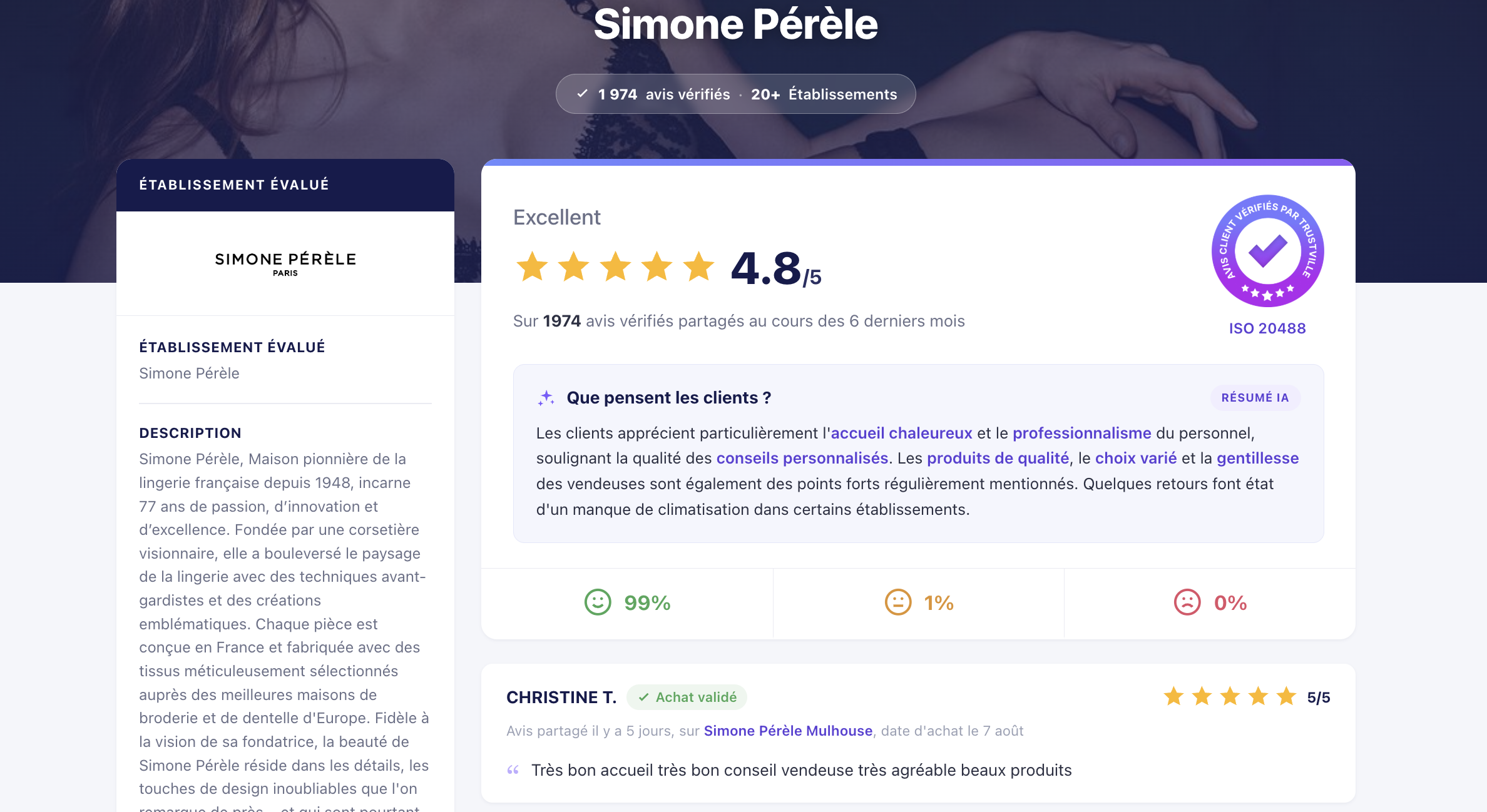
Trustville now displays a neutral, factual summary of customer reviews at the top of the page.
It is based on the latest 1,000 reviews and is automatically regenerated at the start of each month, so the summary evolves with the most recent feedback.
It is generated as soon as at least ten reviews with a comment can be analysed, to avoid a summary based on too small a volume.
Available in several languages, it lets readers quickly identify:
- the location's main strengths;
- the topics mentioned most often;
- recurring reasons for satisfaction or dissatisfaction.
Its wording stays descriptive, with no sales tone. This neutrality and freshness make the information easier to read for users and easier to interpret for search engines.
Better-structured information for search engines
The Trustville redesign also improves how information is described technically, with structured data tailored to each type of page.
Each page type has suitable markup.
On location pages, search engines can identify the store, its address, its overall rating, its individual reviews and its position in the breadcrumb trail.
On brand pages, they find the organisation, its aggregate rating and its place in the site hierarchy.
Pages listing locations use a structured list of stores with their ratings. The page listing brands follows the same logic and includes a marked-up search function.
This organisation helps Google distinguish the site, the brand, the network and each location.
Title tags and meta descriptions now include the rating and the number of reviews, for example:
"Intersport reviews – 4.5/5 from 10,000 verified reviews"
This data therefore appears directly in search results. It gives users and search engines alike information that can be read at a glance on the level of satisfaction and the number of experiences behind it.
Sitemaps are also split by brand and by location. Non-strategic paginated pages are excluded from them, to limit duplicate content and focus crawling on useful pages.
Visibility is not limited to Google either. Trustville now submits its page updates through IndexNow, reporting recently changed content every day, and its indexing on Bing Webmaster Tools has been strengthened.
The aim: generative engines that rely on indexes other than Google's, such as conversational models, should also have an up-to-date view of Trustville pages.
Finally, the rating in the structured data always matches the reviews actually displayed on the page. This consistency makes the whole system more reliable.
Verified reviews as trust signals
Verified reviews act as trust signals because each one carries a date, an author, a rating, a comment, an experience and the location concerned.
Reviews published on Trustville include the information needed to put each piece of feedback in context:
- a date;
- an author;
- a rating;
- a comment;
- an experience;
- the location concerned.
The collection and publication processes are certified: Wizville is certified NF Service « Gestion des avis » by AFNOR Certification (NF522 scheme, www.marque-nf.com).
Trustville therefore lets retailers publish recent, structured reviews linked to verifiable experiences.
According to BrightLocal, 50% of consumers trust AI-generated review summaries. The figure reaches 71% among regular users of these tools.
The summary does not replace the comments, however. It makes them easier to read while still giving everyone access to the original reviews.
To date, no independent study has shown that AI Overviews systematically favour verified reviews. However, these reviews provide elements consistent with the quality criteria search engines look for:
- an identifiable origin;
- a contextualised experience;
- a date;
- a specific location;
- visible, structured information.
They therefore provide material that is more traceable, more recent and more usable than a simple marketing claim.
Measuring how AI perceives retail brands
Wizville's Perception Benchmark now analyses how AI tools present a brand and its competitors.
In the Wizville Perception Benchmark, users can notably:
- identify trends in reviews;
- analyse consumer expectations;
- dig deeper into recurring topics;
- get targeted recommendations;
- compare how several brands are perceived.
The aim is to understand how a brand is described, which themes are associated with it and which factors can influence its visibility in new search environments.
As Timothée De Laitre, CEO of Wizville, puts it: "To be effective, customer satisfaction management must cover the entire customer journey, using a complete platform that lets you take action directly while feeding the AIs."
This is precisely what the latest development of the Wizville benchmark, the AI Perception Benchmark, measures.
What this changes for retailers
With this redesign, Trustville no longer just publishes verified reviews: it also structures a network's local presence and makes it easier for people and search engines to read.
The platform also helps to:
- structure a network's local presence;
- clearly link the brand to its locations;
- make information easier to explore;
- turn reviews into concise, up-to-date content;
- make them easier for search engines to interpret;
- strengthen the trust signals available to consumers.
The AI summary, structured data and the new page organisation help visitors understand a location's strengths more quickly.
They also give Google and generative engines a clearer picture of the brand, its network and the experience offered in each store.
Trustville thus becomes infrastructure dedicated to retailers' reputation and local visibility.
Want to discover the latest Trustville developments and their impact on the visibility of your stores? Let's talk about your local strategy.
Image source: Canva




