






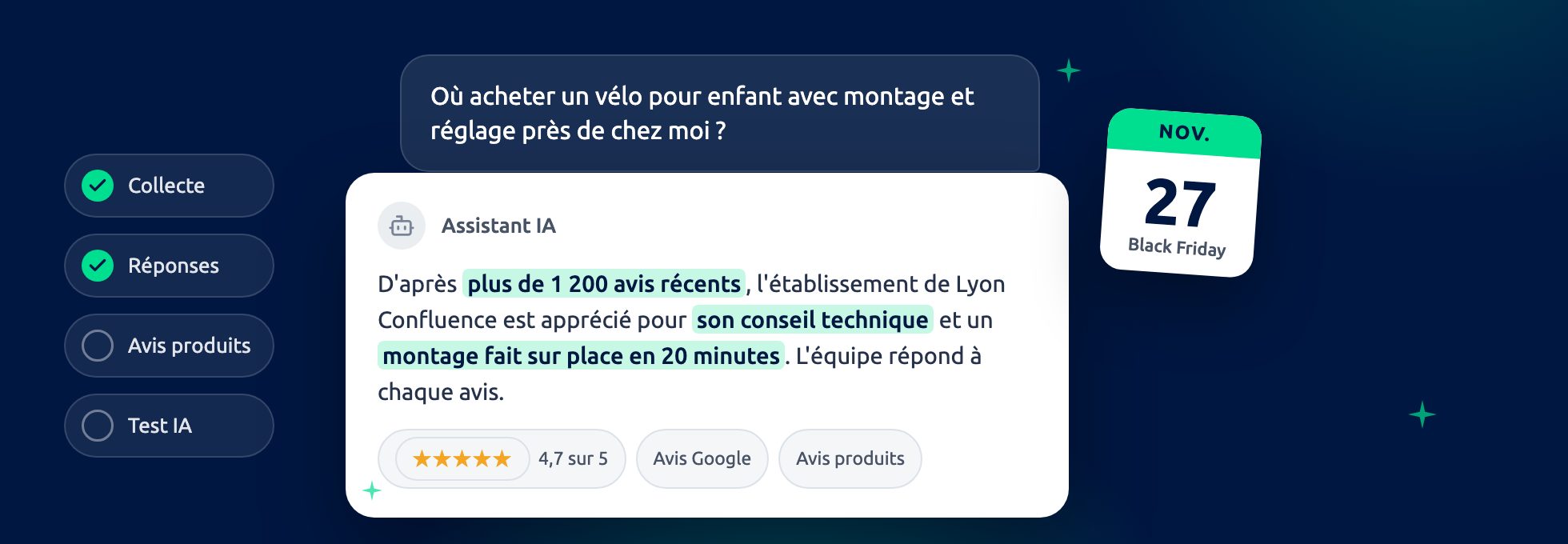
In November 2026, ahead of Black Friday on 27 November, we noted that some of your customers would not read your hundreds of reviews themselves. They would ask an AI search engine to read them, then tell them where to buy. That summary needs to be prepared as carefully as a shop window.
With a little over two weeks to go before 27 November 2026, this article set out four workstreams to roll out across a network of locations, on the following timetable:
- 10 to 15 November – workstream 1, open up review collection: one link per location and a survey after every purchase.
- 10 to 15 November – workstream 2, reply to pending reviews: the most recent first, with a target response time for the festive season.
- 16 to 22 November – workstream 3, reviews on your best-selling products: 20 to 50 product lines, displayed on your website and in Google Shopping.
- 23 to 26 November – workstream 4, ask AI what it says about you: five to ten queries, several assistants, and fix whatever is missing.
What did shoppers plan to ask AI for Black Friday 2026?
Shoppers mainly planned to use AI to compare prices, and a significant minority wanted it to summarise reviews for them.
According to a Klaviyo survey of 1,000 people in France, reported by The Media Leader (in French) on 1 October 2026, 68% of respondents planned to use an AI search engine for their end-of-year shopping. The most common use cited was comparing prices (34%). And 17% intended to ask it to summarise reviews and other information available online.
YouGov (in French) measured the same shift for Black Friday itself: 49% of potential Black Friday and Cyber Monday shoppers were considering using AI for their purchases, compared with 33% in 2025.
An honest caveat: these are stated intentions, not measured behaviour. There is always a sizeable gap between "I plan to" and the evening of Black Friday. But even at 17%, that is a lot of shoppers whose first impression of your brand will be a paragraph written by a machine, based on what your customers have written.
Key figures
68% planned to use an AI search engine for their end-of-year shopping, 34% to compare prices and 17% to summarise reviews and online information (Klaviyo, via The Media Leader, 1 October 2026, 1,000 people surveyed in France).
49% of potential Black Friday shoppers were considering using AI, compared with 33% in 2025 (YouGov, 12 October 2026).
What does an AI summary take from your reviews?
An AI summary draws on four things in your reviews: how recent they are, how many there are, how detailed they are and whether the business replies.
AI search engines do not explain precisely how they work, so we are sharing one of the frameworks we use internally to audit a location's customer reviews. In short, there are four key criteria:
Recency. A summary relies on what describes the location as it is today. Reviews from 2023, however glowing, describe a different team and a different product range.
Volume. The more reviews there are, the more the summary reflects a trend rather than two or three isolated voices.
Detailed verbatim. "Great" cannot be summarised. "Precise advice on sizing, alteration done in twenty minutes" summarises very well, and it is exactly the kind of sentence a shopper is looking for.
The location's replies. They show that there is someone behind the counter, and they add context to the review itself.
Here is an example of the kind of summary an AI assistant might write when asked "Where can I find a coat with good sizing advice in Bordeaux?":
"The city-centre store is often recommended. Reviews from November (recency) praise precise advice on sizing, and across more than 800 reviews (volume) the trend is clear. One customer mentions an "alteration done in twenty minutes" (detail). The team replies to reviews (replies), including questions about lead times."
To go further, see our articles on the launch of Google AI Overviews in France and what it means for the visibility of local retailers and on verified customer reviews as the fuel of GEO.
Week one (10 to 15 November): how do you increase the flow of customer reviews?
You increase the flow of reviews by giving every November customer a simple opportunity to share feedback, both in your locations and online.
Objective: reviews collected from this point would be the most recent ones available to AI search engines during the festive season.
No customer listening programme yet? Start simple: a QR code or an NFC plate leading to your Google listing, at the till and on the receipt, and the habit of asking every customer for a review. It is quick to set up. But it only reaches customers who are in the store, and mostly the most motivated ones.
Already running a post-purchase survey? You have a head start: every customer is asked, including those who would never think of leaving a review on their own. That is what gives an accurate picture of your experience. Use it to invite all your respondents to post on Google. And if your reviews are collected from customers who genuinely made a purchase, then checked by an independent third party, say so: verified customer reviews are a signal of reliability, for your customers and for AI search engines alike.
In both cases, here are the actions for the week:
- Check that every location has an up-to-date, active Google Business Profile (formerly Google My Business), as well as listings on the other local directories where your customers can leave reviews, such as PagesJaunes in France.
- Send a satisfaction survey after every purchase, for all your locations: by email or SMS when you have the customer's contact details, otherwise by QR code in the store or on the receipt.
- At the end of the survey, invite all respondents, whatever their level of satisfaction, to share their experience on the Google listing of the location concerned.
- Add a follow-up question that prompts for detail ("What helped you most during your visit?") to get detailed answers rather than a simple "good".
Also from 10 to 15 November: how should you prioritise replies to customer reviews?
Reply first to the reviews that express dissatisfaction, the most recent ones and those from your busiest locations, because your replies shape how every review is read and interpreted.
Objective: your replies enrich the context in which reviews are read and interpreted.
- List the unanswered reviews, location by location.
- Prioritise: the most recent, those from the locations busiest in November, and those that ask a specific question or express dissatisfaction.
- Reply in the brand's tone of voice and in the customer's language.
- Anticipate the surge of reviews around Black Friday: set a target response time and name a person responsible in each location.
In Wizville, WizAI, the AI colleague, suggests a reply to each review in the brand's tone and in the customer's language. A person reads it, adjusts it if needed and approves it before publication: the AI drafts, the team signs. This is what makes it possible to clear a backlog of several hundred reviews in a few days without sacrificing the quality of the replies.
Week of 16 to 22 November: how do you get reviews on the products that will sell?
Identify the 20 to 50 product lines that will make up most of your end-of-year sales and collect reviews on them first, so that December's best-sellers do not arrive with an empty product page.
Objective: December's star products should arrive with reviews, not with an empty product page.
Start by identifying the 20 to 50 product lines that will account for most of your end-of-year sales, then follow the path that matches your situation.
You already collect product reviews
- Ask customers who bought these products first, starting with the most recent purchases.
- Check that these reviews display correctly on the relevant product pages.
- If your review feed to Google Shopping is active, check that your star products reach the minimum of three reviews Google requires before showing star ratings.
You do not yet have any product reviews on your website
- Do not rely on Google Shopping to fill the gap: Google only displays the reviews you send it, and only above a certain volume.
- Start collecting now. Reviews requested after November and December purchases will arrive during the sales peak and will prepare the ground for the January sales.
- Choose a solution that covers the whole chain: collecting the review after purchase, moderating it, displaying it on the product page and sending it to Google Shopping.
This is what Wizville does with Trustville: each review is requested from a customer who actually bought the product, then moderated and published on your product pages and in Google Shopping. Wizville is certified NF Service « Gestion des avis » by AFNOR Certification (NF522 scheme, www.marque-nf.com); read more about this certification.
Final stretch (23 to 26 November): how do you find out what AI says about you?
Ask AI search engines the questions your customers would ask, note what comes out, and correct what is missing before your customers read it.
Objective: read the summary before your customers do.
- Write five to ten queries your customers might ask ("where to buy trail running shoes near Lyon", "which toy shop in Nantes has good sales staff").
- Ask them in several AI search engines: ChatGPT, Gemini, Perplexity and Google's AI Overviews. Use a private browsing window and ask each query two or three times.
- Note what comes out: is your brand cited? Which locations? With what arguments, and based on which sources?
- Fix what is missing: end-of-year opening hours, categories, incomplete location listings.
It is the only pre-Black Friday test where nobody will ask you for a discount code. Keep your notes: by asking the same queries again in a few months, you will know whether your visibility in AI search engines has improved.
What happens after 27 November?
Black Friday is only the first peak: the reviews collected before it also feed the AI summaries used for Christmas and the January sales.
Reviews collected up to 26 November will also count for Christmas: in December, AI search engines can draw on them to advise gift shoppers. Then come January's reviews: returns, exchanges, sales. A collection campaign launched in mid-November and stopped on 28 November leaves January's summary to feed on older reviews. The good news: these four workstreams are not a sprint. Once in place, they run all year round.
How can you prepare the way AI reads your network?
Bring review collection, replies to reviews and verified product reviews together on one platform, for all your locations.
Collection, replies to reviews, verified product reviews: Wizville brings these workstreams together on a single platform, for all your locations. We can review with you your reviews, your replies and what ChatGPT, Gemini or Google take from them, on the key queries in your sector.
Request a demo or discover online reputation and GEO management.
Wizville



