






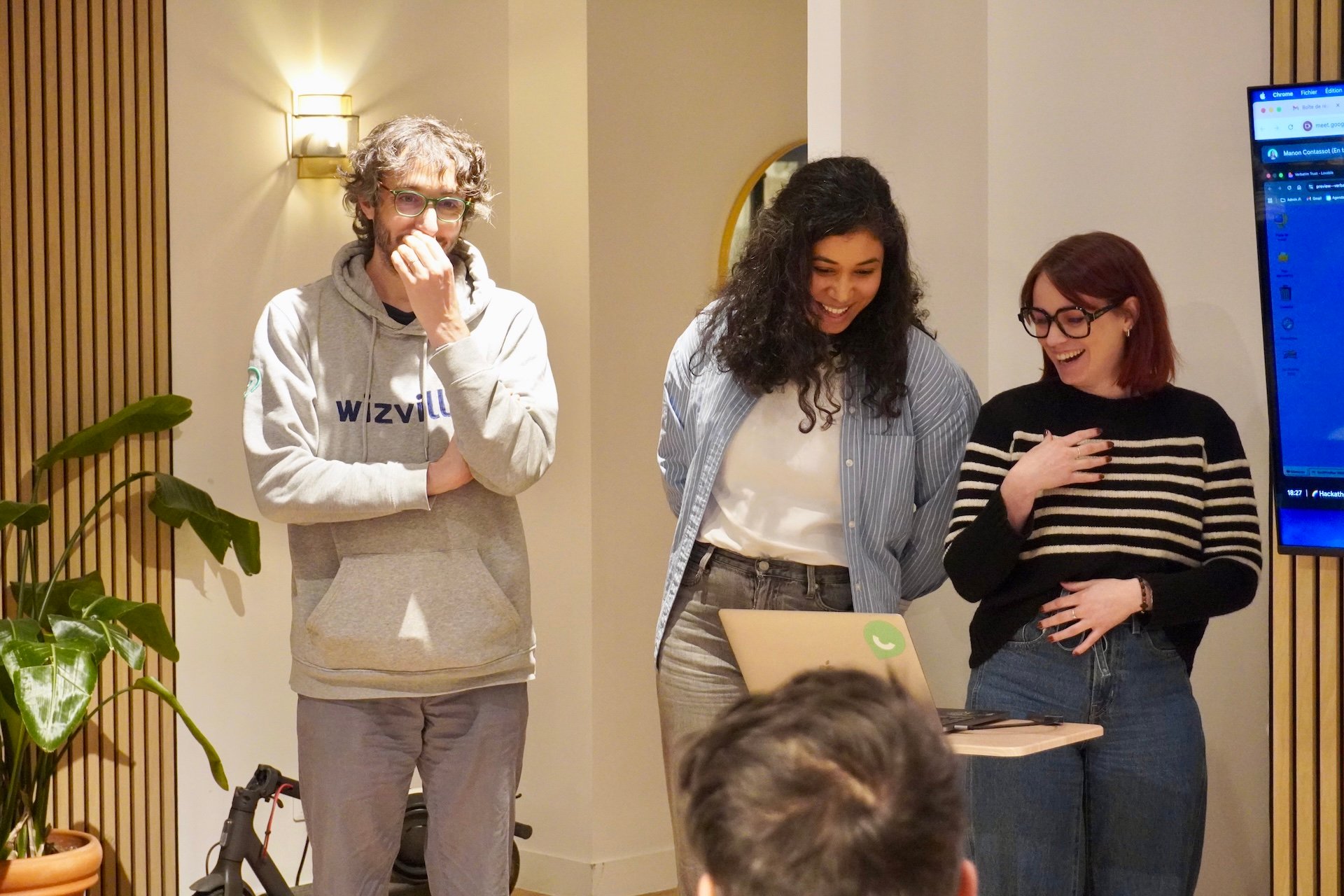
In March 2026, Wizville noticed that some of its operational friction did not come from the Wizville product itself.
It came from problems that were well known but kept waiting, for lack of time or priority on the technical teams' side.
Preparing client meetings faster. Getting hold of the right data. Automating repetitive tasks.
None of it critical on its own. But taken together, these irritations directly slow down execution. So we tried a different approach.
On 13 March 2026, we held an internal hackathon with a simple goal: to let everyone turn a business problem into a working tool in one day, using AI.
Building instead of working around
The hackathon's idea was to let business teams build their own tools instead of working around problems. In most organisations, business teams find workarounds: Excel files, improvised processes, internal hacks.
"Vibe coding" changes that logic.
With tools such as Lovable, Replit or Claude Code, it becomes possible to create tools simply through prompts, without advanced technical skills.
It is no longer just a question of using software. It is the ability to create software on demand, from a specific need. And above all, without depending on a product cycle.
A tough constraint: deliver in one day
Each team had to deliver a working tool by the end of a single day. The format was deliberately simple and demanding:
- scoping in the morning
- a short training session
- a day of building
- a presentation with a demo
Only one rule: every team had to deliver a working tool at the end of the day. No concepts. No half-finished prototypes.


15 tools, ready to use straight away
In one day, the teams built 15 projects, and several were in use the following week.
A few examples:
- WizCollab Studio: a tool to structure and automate the set-up of employee groups and permissions on the client side. Less manual handling, more clarity, simpler onboarding.
- Survey Builder: automatic generation of multilingual surveys adapted to the sector and context, based on Wizville templates. An immediate time saving and wider sharing of best practice.
- Wiz Wrapped: generation of personalised annual reviews that are more engaging and much faster to produce.
But beyond these projects, the key point lies elsewhere: some tools were built by non-technical people, in a few hours, on topics that had been waiting for months.
What about security?
Security is a legitimate question, and the tools built during the hackathon went through the same security standards as the rest of our internal tools.
Letting teams create their own tools faster inevitably raises the question of the framework: data, security, governance.
In our case, the tools developed during the hackathon did not remain isolated prototypes.
They were reviewed and approved by our technical management, then integrated into our internal tools with the usual security standards (authentication, controlled access, two-factor authentication).
The aim is not to get around security requirements, but to allow a first phase of rapid experimentation before bringing the relevant solutions back into a controlled framework.
What it changes in practice
This kind of initiative reveals a deeper change: the boundary between product teams and business teams is starting to disappear.
Speed of execution no longer depends only on development capacity, but on the ability to state a problem clearly… and to iterate quickly.
In other words, teams that know how to "prompt their own job" gain a structural advantage.
A direct lever for operational performance
In a SaaS company, performance does not rest on the product alone.
It also depends on the ability to:
- reduce internal friction
- speed up workflows
- build on best practice
Letting teams create their own tools acts directly on all three levers.
What next?
The hackathon was not a one-off initiative but a first step towards a new way of working.
It is a first step towards a model where:
- every team can build its own solutions
- business problems are dealt with continuously
- AI becomes a tool for execution, not just for analysis
The real challenge is no longer using AI. It is giving everyone the ability to turn a problem into a solution, without structural dependence.




