






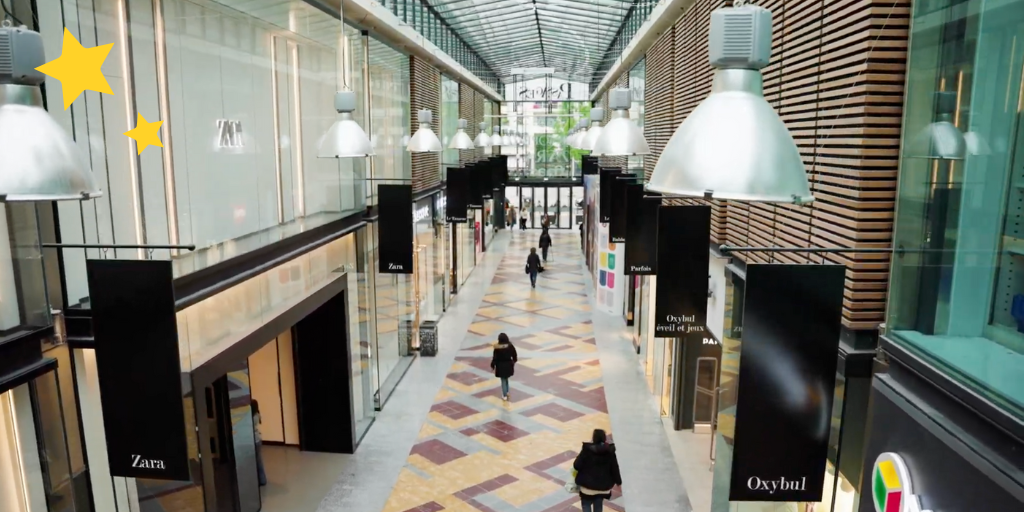
Shopping centres are a fixture of the retail landscape in France.
- Cushman & Wakefield: in 2023, 89% of French people visited a shopping centre, and 69% did so regularly (in French).
- Fédération des acteurs du commerce dans les territoires: footfall in shopping centres rose by 1.1% over 2024 as a whole.
Yet competition, regulation and changing consumer expectations mean that shopping centres are constantly transforming. They are no longer just places to shop, but places to spend time and meet people, and they now offer new services such as health, wellbeing and leisure.
To attract customers from their catchment area, centres therefore have to work on their appeal.
"Our ambition is to create the favourite shopping destinations in each of our centres' catchment areas."
— Solenn Glory, Customer Experience Director, Klépierre
Winning customers' preference starts with understanding what they expect. Making use of customer feedback is the key to managing the customer experience and building a long-term vision.
This article explains which objectives customer feedback serves for shopping centre managers, and how to put it to work.
Why should shopping centres make use of customer feedback?
Customer feedback helps shopping centres improve the visitor experience and day-to-day operations, feed their short- and long-term action plans, and strengthen their position against competing centres.
Improve the customer experience and the running of the centre
Like Klépierre, shopping centres have one clear priority: to become customers' favourite shopping destination in their catchment area.
That depends on an excellent customer experience.
"The customer experience must therefore be flawless, experiential and enriching. Our centres must be hubs where people discover new things and meet each other. That is why we design our shopping centres as places to live: safe, welcoming, hospitable places where there is always something to discover with family and friends, and where everyone feels at home. Spaces designed to offer ever more services and comfort, with careful attention to design."
— Solenn Glory, Customer Experience Director, Klépierre
To achieve this, you need to know visitors' expectations, feelings and sources of dissatisfaction.
Customer feedback helps shape the shopping centre into a real place to spend time: calm, welcoming and enriching, somewhere everyone enjoys coming back to with family or friends.
Making use of customer feedback is essential, particularly to improve common areas and the overall experience.
Collecting and analysing reviews helps you identify:
- Strengths to promote (children's areas, atmosphere, accessibility).
- Pain points to fix quickly (cleanliness, signage, visitor flow, security).
These concrete indicators drive operational decisions: maintenance work, changes to events and activities, updated signage and so on.
Feed short- and long-term action plans
By analysing customer feedback, shopping centre managers gain the insights they need to plan and prioritise their actions.
These insights work on two timescales:
- In the short term, managers respond to day-to-day incidents and suggestions (cleanliness, welcome, security).
- Over the long term, feedback is used to build investment plans (new spaces, structural improvements to the customer journey).
"In the short term, we have put an action plan in place to deal, day to day, with operational issues in our centres (cleanliness, atmosphere and so on) raised by customers through problems and suggestions. For example, the centre manager uses the feedback reported in Wizville to brief the security and cleaning teams. In the long term, listening to customers feeds our investment plans and structural improvements to the customer journey (new rest areas, children's play areas). Wizville helps us understand the main pain points and what customers expect."
— Flavien Mougin, Customer Intelligence Manager, Klépierre
Strengthen the centre's competitiveness
Customer feedback is also a way to assess how competitive a centre is compared with its rivals.
Wizville's competitor benchmarking feature lets Klépierre compare its centres with their competitors on the basis of customer reviews.
"This Wizville feature aggregates the Google scores of our centres and their competitors, and lets us compare satisfaction scores at a glance. It means we can monitor the performance of our customer experience strategy and make sure that our centres remain leaders in their catchment areas, or gain ground on their competitors. Wizville also helps us identify our competitors' strengths so that we can build our action plans accordingly (retail offer, customer experience and so on)."
— Flavien Mougin, Customer Intelligence Manager, Klépierre
As Flavien Mougin explains, Klépierre also uses benchmarking at another level: the retailers within its centres.
"We use this benchmarking feature across our centres' catchment areas, but also within each of our centres, to assess how satisfied our visitors are with the retailers there. It helps us manage the mix of retailers in our centres more effectively, inform our negotiations with retailers and, ultimately, boost visitor satisfaction."
How can shopping centre managers make use of customer feedback?
Shopping centre managers make use of customer feedback by collecting it across several channels, analysing it with a dedicated tool and building it into the way their centres are run.
Define the right mix of collection channels
"Together with Wizville, we built a questionnaire for our visitors to gather their views on their overall experience in our centres and on different points of the customer journey in the centre (accessibility, signage, retail offer and so on). This questionnaire helps us understand why customers are satisfied or dissatisfied, and what they expect." — Flavien Mougin
To collect enough reviews, and representative ones, shopping centres need to set up feedback collection across several channels:
- Multichannel surveys and questionnaires: sent by email or SMS, through the centre's app or offered via QR codes on site, they provide structured feedback on the whole visitor journey. Questions tailored to the visitor's profile and context (shopping, dining, events) make them more relevant.
- Satisfaction kiosks: installed in common areas (toilets, car parks, exits), they let visitors give quick feedback by pressing a smiley button. Their short, intuitive format encourages people to respond in the moment, although they favour quantity over qualitative detail.
- Online reviews and social media: platforms such as Google and Facebook gather spontaneous and often detailed opinions. Centralising this data in a dedicated tool lets you make the most of the wealth of information in public reviews.
Analyse and share the data
Given the volume of feedback, a satisfaction management solution then becomes essential.
"Customer satisfaction is key to designing an optimised customer journey, and we monitor and improve it with Wizville. In particular, Wizville lets us collect our customers' reviews, both through questionnaires and by centralising Google reviews. We collect more than 800,000 reviews a year to understand our customers better. In early 2024, we also rolled out AI-generated replies to make it easier to manage the feedback our centres receive."
— Klépierre
Solutions such as Wizville centralise all feedback, whatever channel it comes from, then break it down by theme: accessibility, cleanliness, atmosphere, security and more.
Semantic analysis gives a concise overview of the most prominent strengths and pain points.
Finally, AI can generate personalised replies at scale, making large volumes easier to handle and speeding up response times.
Build customer listening into operational management
To make customer feedback analysis actionable, it also has to be embedded in the company's culture and practices.
That means dashboards tailored to each stakeholder, and insights that are clear and easy to share.
For example, immediate feedback lets managers quickly adjust the organisation (cleaning, welcome, security) or brief teams on a specific issue.
Customer feedback is also the basis for action plans. It enables quick fixes when customers report dissatisfaction with a specific point that can be corrected straight away. It also informs strategic decisions about how the centre evolves over time (new spaces, services, refurbishments).
Finally, customer feedback is also an internal communication tool, especially between centre managers and the retailers in their centres.
Actively listening to shopping centre visitors improves the customer experience, operational management and strategic decision-making.
This approach puts the customer at the heart of the retail project, strengthening the centre's appeal and performance in its competitive environment.
Find out how Klépierre uses customer feedback to make its centres consumers' favourite shopping destinations in the video below (in French).




