







In e-commerce, displaying product reviews is a must. According to an IFOP / Opinion System study, half of French consumers believe that products sold by a company that publishes no customer reviews are of lower quality.
Yet in 2021, e-commerce still accounted for only 14.1% of retail in France. So what about displaying customer reviews in physical stores?
A 2017 study by PowerReviews found that 70% of consumers want access to product ratings and customer reviews when they visit a physical store — but at the time, companies had not yet invested heavily in this area.
And yet most shoppers do their shopping with a smartphone in hand. Many Gen Z consumers are keen on augmented reality when they shop.
Given these expectations, combining the physical experience with digital elements is a lever for improving in-store conversion rates.
Product reviews have every place in these set-ups. In this article, we explain why and how to use them, with examples.
In-store product reviews: a must-have?
In-store product reviews means making ratings and reviews available to visitors at the point of sale.
Reviews can be presented in several ways:
- On shelf labels with a QR code
- On in-store digital displays
- Through mobile apps
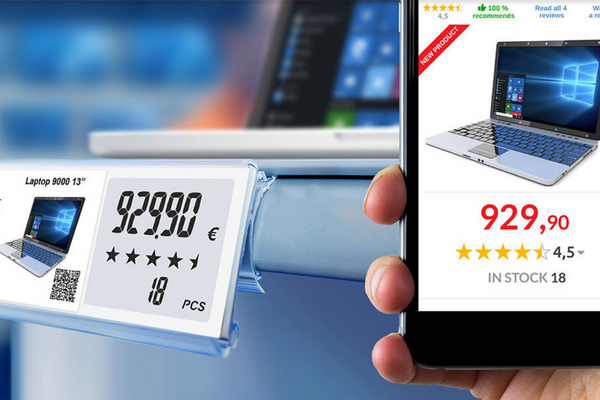
(credit: ellaretail.com)
The aim of these set-ups is to give consumers relevant information to help them choose.
Displaying your product reviews in store has several benefits:
- Increase your sales: consumers trust their peers' reviews more than information provided by brands. Reviews raise the perceived value of products and generate more sales.
- Improve customer satisfaction: with reviews, customers make purchase decisions with better information, which reduces the risk of a poor choice. As a result, they are more likely to be satisfied with their purchase and with the in-store experience.
- Reduce returns: shoppers make better-informed decisions when they take reviews into account. The risk of a poor choice falls, and so does the likelihood of them returning the product.
- Become more competitive: in-store product reviews are a way to stand out from your competitors with an enriched shopping experience.
Product reviews help undecided shoppers make up their minds. Reducing indecision makes it easier to act. When every competitive gain counts, it would be a shame to miss out on a lever that has a positive impact on in-store conversion.
Why take control of your product reviews in store?
Making product reviews available in store meets consumer demand.
In the age of social networks and communities, the "social buyer" distrusts corporate communication, which they have learnt to recognise. They do, however, rely on other consumers' reviews, which they see as impartial. The habit of checking reviews online carries over into the "real world".
Consumers are also hungry for transparency. Apps such as Yuka have appeared to inform consumers about the nutritional quality of food products or the conditions in which a garment was produced. But retailers have no control over these independent apps.
So how can you meet this need for transparency?
The obvious answer: by displaying product reviews that you have collected yourself.
According to BrightLocal's annual survey of customer reviews, 49% of consumers trust customer reviews as much as personal recommendations from family or friends. And, of course, to remove any doubt, it is best to display only reviews verified by a trusted third party.
In the future, it will be hard to do without in-store reviews. 57% of Gen Z consumers already shop with their phone in hand as a matter of course. They are also showing growing interest in augmented reality in store. In a few years, product reviews will be taken for granted. Services such as virtual try-on for clothing are also likely to develop.
You are convinced of the value of displaying your product reviews in store, but you are wondering how to put it into practice. Here are a few examples to inspire you.
3 concrete examples of in-store product reviews
Amazon: stores designed around customer reviews
In 2018, Amazon took the logic of customer reviews to its extreme by launching its Amazon 4-star stores. The concept's distinctive feature was that every product on sale was rated at least 4 stars out of 5 by consumers, or was among the company's best sellers.
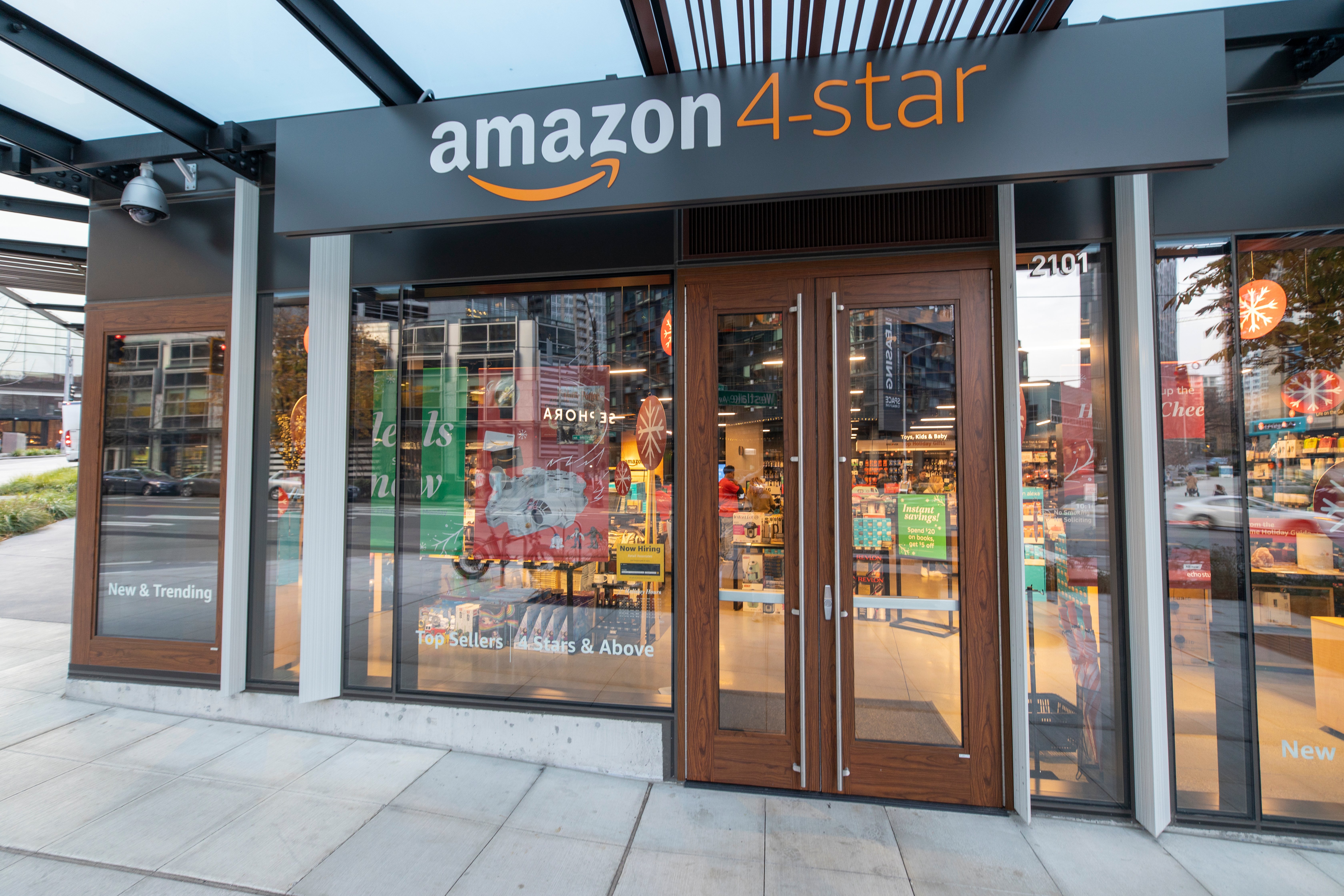
(credit: Shutterstock, Cascade Creatives)
The products in these stores came from many categories (computer equipment, consumer electronics, household appliances, homeware, toys, books, and so on).
Customer reviews were highlighted on electronic price labels, which showed both the standard price and the discounted price for Amazon Prime members. The information was updated in real time. For greater transparency, the average rating was always shown alongside the total number of customer reviews collected for the product.
In March 2022, Amazon announced that it would close these stores. The concept remains a source of inspiration, though. Stores could, for example, set up aisles or areas dedicated to the products best rated by consumers.
Leroy Merlin and Decathlon: customer reviews and ratings displayed on the shelf
Putting customer reviews directly on the shelves of physical stores reduces the effort customers have to make to access the information.
Several approaches are possible.
French DIY retailer Leroy Merlin, for example, chose to display on laminated signs the rating of some of its flagship products, together with the total number of customer reviews collected. Effective at catching shoppers' eyes and convincing a hesitant customer, this kind of set-up simply requires continuous collection of customer reviews, so as to maintain a minimum representative sample of feedback.
(source: Olivier Dauvers)
Decathlon, for its part, prefers to highlight a single customer review per rated product. These testimonials (naturally always positive) are particularly useful when they give the shopper extra information about the product: durability, recommended use, comfort, and so on.
Displaying reviews on the shelf in this way makes them more visible to consumers than when they are built into price labels. However, the space each review needs limits how many can be shown.
Each retailer therefore has to choose a selection of products to highlight: private-label products, best sellers, partnerships with certain brands — there are plenty of options.
Conclusion
Displaying product reviews in store responds to consumers' desire for more transparency, and even for an augmented in-store experience. It is also driven by the habits shoppers have formed online.
For retailers, it is a lever for building trust and reassurance around the products on offer… and for boosting sales.
Upstream, it requires a system for collecting product reviews and, ideally, having the reviews verified by a trusted third party.
The good news: we can help.


