







Product reviews have a strong impact on conversion, particularly in e-commerce. Some retailers have understood this and put systems in place to automate the collection and display of verified reviews.
Those who took a proactive approach have gained a head start. In time, the whole market is likely to follow, because shoppers increasingly rely on reviews to inform their purchasing decisions.
The question is therefore no longer whether to invest in product reviews, but how to get the most out of them.
How can you prepare now for a world in which reviews carry ever more weight? Here is our advice for anticipating the future of product reviews.
How are product reviews likely to evolve?
Product reviews are likely to grow sharply in volume and, in time, to be expected to be verified as standard.
A surge in the number of product reviews
The volume of product reviews posted on digital channels keeps growing.
It rose markedly during the COVID-19 pandemic: according to McKinsey, the number of reviews increased by 87% between December 2019 and December 2020. Admittedly, consumers were ordering more online and, with lockdowns, had more time to write a review.
But this rise is part of a wider trend. Consumers increasingly look for and share reviews before making purchasing decisions.
In his book Marketing Rebellion, marketing expert Mark Schaefer even sees this as a new paradigm.
In his view, brands are no longer in control. Consumers can make or break them, thanks to channels of expression (reviews, social media and so on) that give them a new kind of power. As a result, companies now need to replace traditional marketing with consumer-generated marketing.
As new generations of consumers arrive, raised on social media, likes and user-generated content, the habit of speaking up and sharing an opinion is likely to grow even stronger.
Verified reviews… and nothing else?
This shift is already well under way. Customers refuse to be misled by suspicious reviews, and dubious reviews already work against the brands that display them. Verifying reviews by linking them to proof of purchase is already a powerful way to reassure shoppers.
In time, it could become a legal requirement. To protect consumers from abuse, lawmakers may well require every retailer to verify its reviews.
That would guarantee, for the whole ecosystem, that every review shared is real, authentic and reliable.
In previous articles, we explained how to collect more verified reviews by including the review request in your post-purchase surveys. We believe this will eventually become the norm.
If so, you will no longer be able to stand out on review volume and authenticity alone. What other levers could you use to differentiate yourself through reviews?
How can you win the product review battle of the future?
To stand out once verified reviews are the norm, brands will need to offer richer review formats, use generative AI to make reviews easier to navigate, and bring reviews into the store.
Offer different product review formats
Today, most product reviews are written reviews. Even when they are authentic and reliable, they do not always help the reader picture how the product will actually be used.
Multimedia reviews could change the way consumers perceive and assess products. Images and videos can:
- give a more accurate picture of products;
- reduce the uncertainty of buying online;
- influence purchasing decisions more strongly than written reviews alone.
Take a furniture e-commerce site. Your prospect is hesitating between several sofas for their living room and reads the reviews. They learn, for example, that "the design and finish are beautiful" and that "the model is comfortable and sturdy". But written reviews tell them nothing about how that sofa would look in their own home.
For this kind of product, pictures speak louder than words. Why not encourage your customers to share a photo of the sofa in their home alongside their written review? Your visitor would then have a gallery of interiors, some of them probably close to their own.
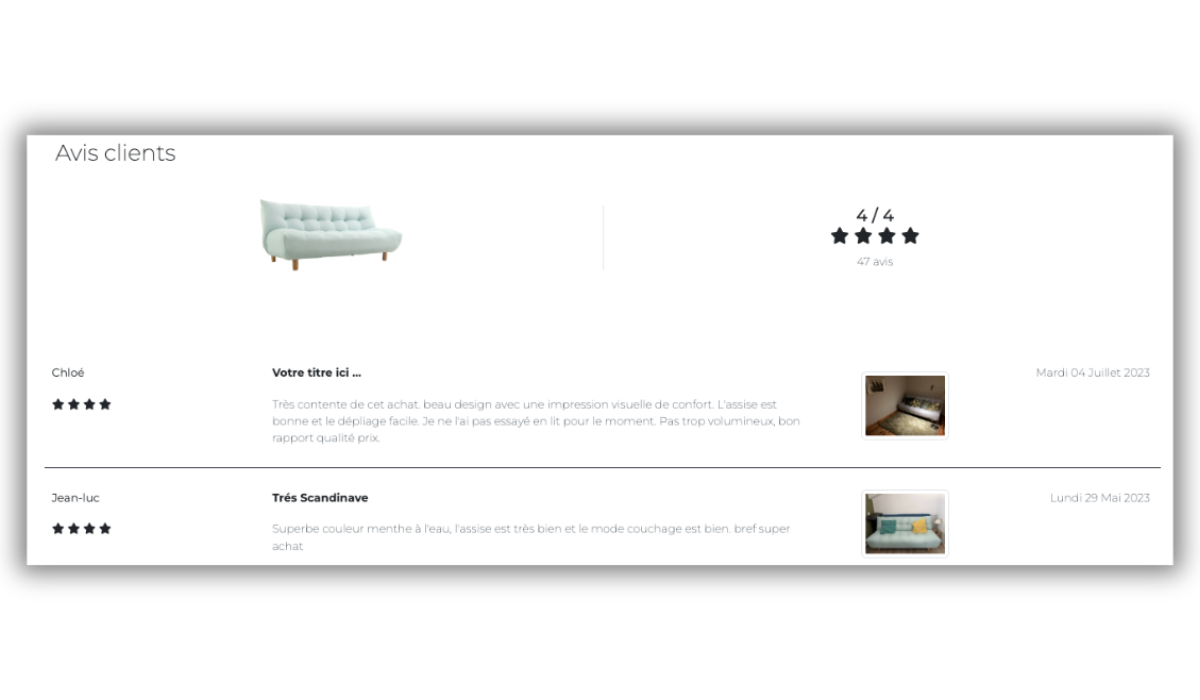
The same goes for clothing. Seeing an item worn by several people with different body shapes helps everyone get a clearer idea of how it would look on them.
For some types of product, an image is not enough. With certain DIY tools, for example, customers may need to see them in action to decide whether they meet their needs. Why not encourage your customers to share a video product review?
With the rise of platforms such as YouTube, Instagram and TikTok, consumers are getting used not only to watching video content but also to creating it.
Photos and videos also create a stronger emotional connection. Sharing becomes more personal and warmer, which can help conversion.
The future of product reviews is therefore converging with the user-generated content (UGC) trend. For brands, the main challenge is to keep encouraging customers to speak up, and to let them do so in the format they prefer. Why not audio, too?
The role of influencers and micro-influencers in product reviews should not be overlooked either. They play an increasingly central part in how product reviews are perceived and shared.
Micro-influencers, in particular, stand out for their ability to build authentic, trusting relationships with their audience. Unlike major celebrities, their content is often more specialised and engages a niche audience with a higher conversion rate. The shoe brand Sperry, for example, worked with more than 100 micro-influencers to promote its shoes, which led to a significant increase in traffic and impressions and showed how effective this type of partnership can be.
In 2024, major brands such as Adidas and Dunkin' were still bringing micro-influencers into their campaigns to reach more specific audiences and obtain more authentic feedback. For brands looking to strengthen the impact of their product reviews, partnering with influencers who can provide visual testimonials, whether video or images, is becoming a winning strategy.
Alongside working with micro-influencers, it is important to strike the right balance between ordinary user-generated content (UGC) and content created by influencers. UGC, which comes directly from customers, is seen as more authentic and neutral because it reflects the real experience of the average consumer. Micro-influencers, although often closer to their audience, can be divisive and bring subjective bias into their reviews.
Working with micro-influencers calls for a strategic approach: their opinion, even when it comes across as honest, can be shaped by partnerships or personal preferences. They can also polarise their followers' views, especially when their opinion differs from the experience of most customers. To avoid these pitfalls, diversify your sources of reviews by combining ordinary customer reviews with micro-influencer content, and stay alert to how that content is presented to and perceived by consumers.
Use generative AI to summarise and categorise product reviews
On most websites, product reviews are presented as a simple list.
If the volume of reviews explodes, prospects will no longer read them all. Several entry points could then be offered.
First, why not use generative AI to give a quick overview of overall opinion, much as the French sports daily L'Equipe does to summarise readers' comments under its articles?
Second, shoppers sometimes need to compare products and therefore to read reviews by topic.
Say a customer wants to buy a garment and needs to know how it fits. Why not let them filter the reviews so that they can read only those that mention sizing?
Going further, AI systems could even personalise recommendations based on the reviews a user has read.
Bring product reviews into the in-store experience
Displaying product reviews in store opens up a range of new ways to enrich how customers interact with products. Online reviews have traditionally dominated, but bringing them directly into the store can have a significant influence on purchasing decisions.
At the heart of this shift, interactive electronic shelf labels are transforming the retail landscape. These devices replace traditional paper labels and do more than display static information such as prices and promotions: they can also show product reviews in near real time. With this technology, customers benefit from instantly updated reviews and ratings, so they can read recent, relevant comments straight from the shelf. Because the display is constantly refreshed, the reviews reflect the latest customer opinions and give a clear, current view of the product's quality and performance.
Adding QR codes to these interactive labels can improve the in-store experience further. By scanning the QR code, customers can instantly access a database of reviews, demonstration videos and even additional images of the product in different settings. In furniture, for example, a customer could watch a video showing a sofa in different interiors, helping them picture how it would fit into their own home.
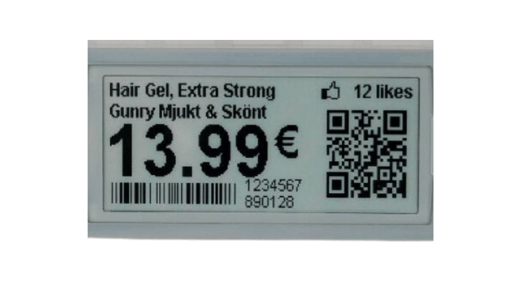
Some companies go further and develop dedicated apps that sync with interactive electronic labels. These apps let customers read reviews, compare products in store, access personalised recommendations based on previous reviews, and receive notifications about similar or complementary products.
Finally, interactive electronic labels are also an excellent way to boost in-store promotions. They can, for example, display particularly positive product reviews alongside a promotion, or loop video demonstrations of complex or technical products such as DIY tools.
The use of these technologies is set to grow, making the in-store shopping experience more immersive and connected and helping consumers make better-informed decisions. For brands, the aim is not only to improve customer satisfaction but also to raise in-store conversion rates by drawing on the authenticity and trust that product reviews generate.
Image credits: Shutterstock - Miliboo (in French) - Zappos - E-marketing.fr (in French)




