







Customer reviews have a considerable influence on purchasing decisions and shape brands' online reputation.
More than 8 in 10 consumers read them before making a purchase. They place far more trust in the experiences of their peers than in what brands say about themselves.
Many review platforms exist, both general and specialist. However, since 2012, when Google began showcasing Google My Business listings (now Google Business Profile) in its search results, Google has held a dominant position in the market for public customer reviews.
The Digital Markets Act (DMA) aims to restore the balance and ensure fairer competition between players. It prohibits companies that control access to online platforms from favouring their own products or services over those of their competitors.
In this article, we look at how the DMA affects the visibility of customer reviews and what it means for businesses and their review management.
What is the Digital Markets Act?
The Digital Markets Act is an EU regulation that imposes strict rules on the largest online platforms, known as gatekeepers, to stop them abusing their position and to restore fair competition in digital markets.
What are the objectives of the DMA?
The Digital Markets Act proposal is based on an analysis of digital markets.
In its first section, the text states that more than 10,000 online platforms operate in the European market, most of them SMEs. Yet a small number of large platforms capture most of the value generated.
In addition to offering digital services, these large platforms act as gatekeepers between business users and end users. They make businesses and consumers dependent on their services, which secures their dominant position and blocks competition from other platforms.
The aim of the DMA is to tackle the concentration of digital power and restore fair competition between players. To do so, it imposes strict rules on companies designated as gatekeepers, essentially the GAFAM (Google, Apple, Facebook/Meta, Amazon, Microsoft) and ByteDance (TikTok).
What are the main provisions of the DMA?
The DMA sets rules to limit gatekeepers' abuse of their dominant position.
First and foremost, it prohibits these platforms from favouring their own services or products over those of their competitors. They must now give competing businesses fair access to their platforms.
Gatekeepers must also ensure transparency in their commercial relationships with third-party businesses, and put interoperability mechanisms in place to make it easier to access and interact with their platforms.
Until now, penalties for breaches of competition law often came very late. The obligations set by the DMA push the companies concerned to change their behaviour in depth.
These obligations also come with penalties. The European Commission is responsible for monitoring compliance and imposing sanctions in the event of breaches. Offenders face fines of up to 10% of their total worldwide turnover, and up to 20% for repeated infringements.
What impact does the DMA have on customer reviews?
By preventing Google from favouring its own services, the DMA allows reviews from other platforms to appear alongside Google reviews in search results.
The end of Google's dominance?
In France, Google held around 90% of the search engine market when this article was first written.
By showcasing its own business listings in search results, the American company enjoyed a near-monopoly on the visibility of online customer reviews.
As a result, companies concerned about their online reputation had to focus their attention and review management efforts on Google reviews. Businesses that were not well ranked on Google could struggle to get their customer reviews seen.
With a few exceptions in specific sectors, such as hotels and restaurants with powerful platforms like Tripadvisor, only Google reviews were truly visible to users. For most alternative platforms, competing with Google was almost impossible.
Under the DMA, Google must give competing platforms a place in its search results. Reviews from other platforms will therefore sit alongside Google reviews.
How does the DMA affect the visibility of customer reviews?
With the Digital Markets Act now in force, the visibility of customer reviews is changing significantly.
Reviews from alternative platforms (such as Trustville) will gain visibility, since Google can no longer promote its own reviews at the expense of others. Google must now treat all reviews fairly, whatever platform they come from. As a result, the DMA should reduce consumers' reliance on Google reviews.
In this new environment, alternative platforms have an opportunity to gain visibility and credibility. To stand out, they can play on what sets them apart from Google in terms of customer experience: transparency, authentic reviews and verification of the experience (particularly through reviews collected after purchase), which Google does not guarantee.
With the DMA, these platforms can build on their strengths with business users. The lack of visibility they suffered will clearly no longer be an obstacle under the new legislation. Logically, they should attract more users and businesses to their services.
Consumers, for their part, will have access to an aggregated view of reviews from different platforms. Taking an even larger and more varied set of reviews into account should strengthen the credibility of, and trust in, public reviews.
How much visibility have Trustville reviews gained under the DMA?
Since early 2024, Trustville reviews have appeared alongside Google reviews in Google search results and business listings, and inside the list of reviews Google displays.
The DMA entered into force on 1 November 2022 and has applied since 2 May 2023. But it is above all since 7 March 2024 that gatekeepers have had to comply with its obligations and that offenders face penalties.
In late 2023, and above all in early 2024, Google therefore began complying with these new obligations. As the publisher of Trustville, our own verified customer review solution, we have been closely watching the first effects of the new legislation on the visibility of customer reviews.
Google continues to test and change these display formats regularly, but at the time of writing we were already seeing some very significant changes on the accounts of customers using our platform.
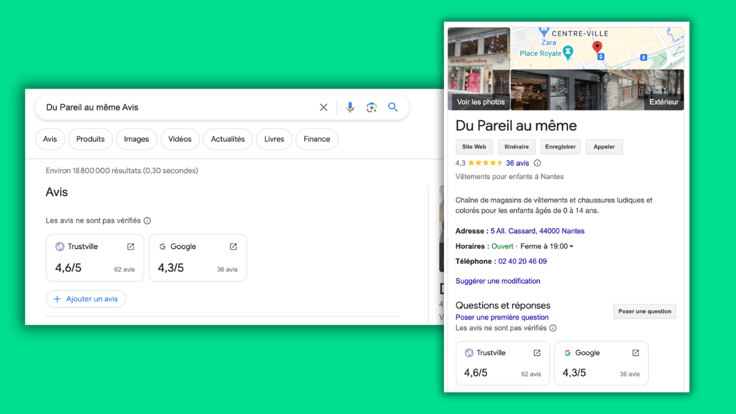
For our customer Du Pareil au Même, a French children's clothing chain, Trustville reviews now appear alongside Google reviews. Clicking the Trustville box takes users to the store's Trustville page. Clicking the "Show all reviews" button brings up a new "Du Pareil au Même reviews" search page, which again shows Trustville reviews alongside Google reviews.
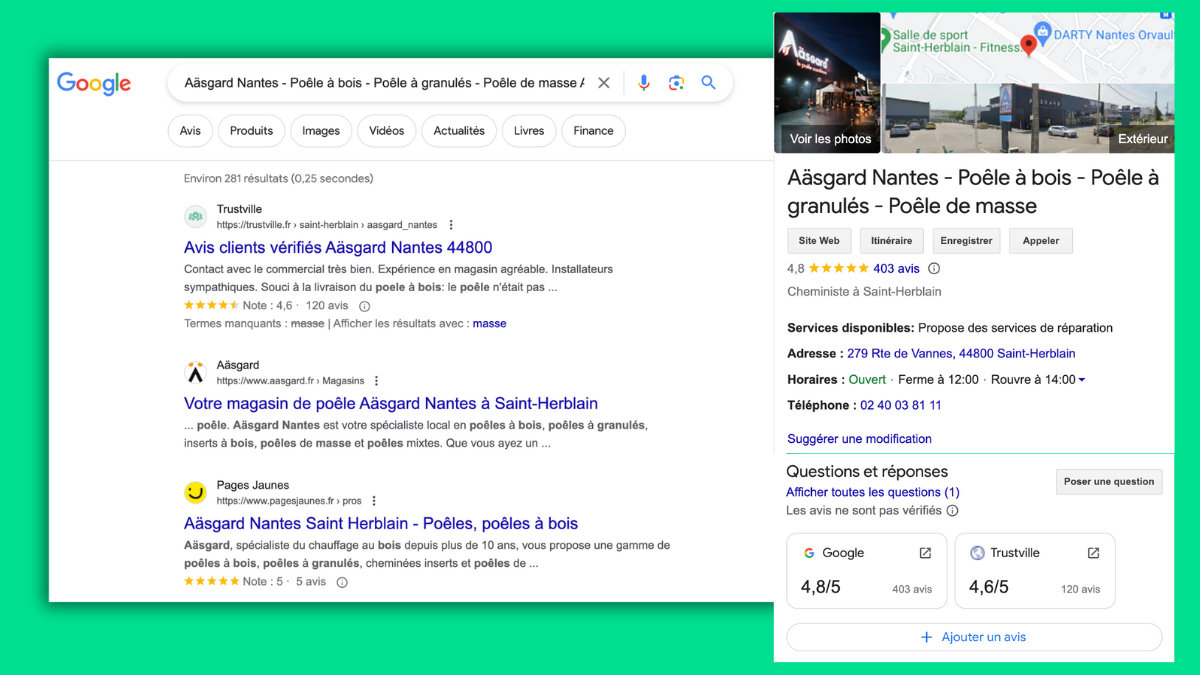
For another customer, Aäsgard, the result is broadly similar: the store's Trustville page appears in first position after clicking "Show all reviews".
Finally, and probably most importantly, reviews collected and published on Trustville now appear directly among the reviews displayed on Google.
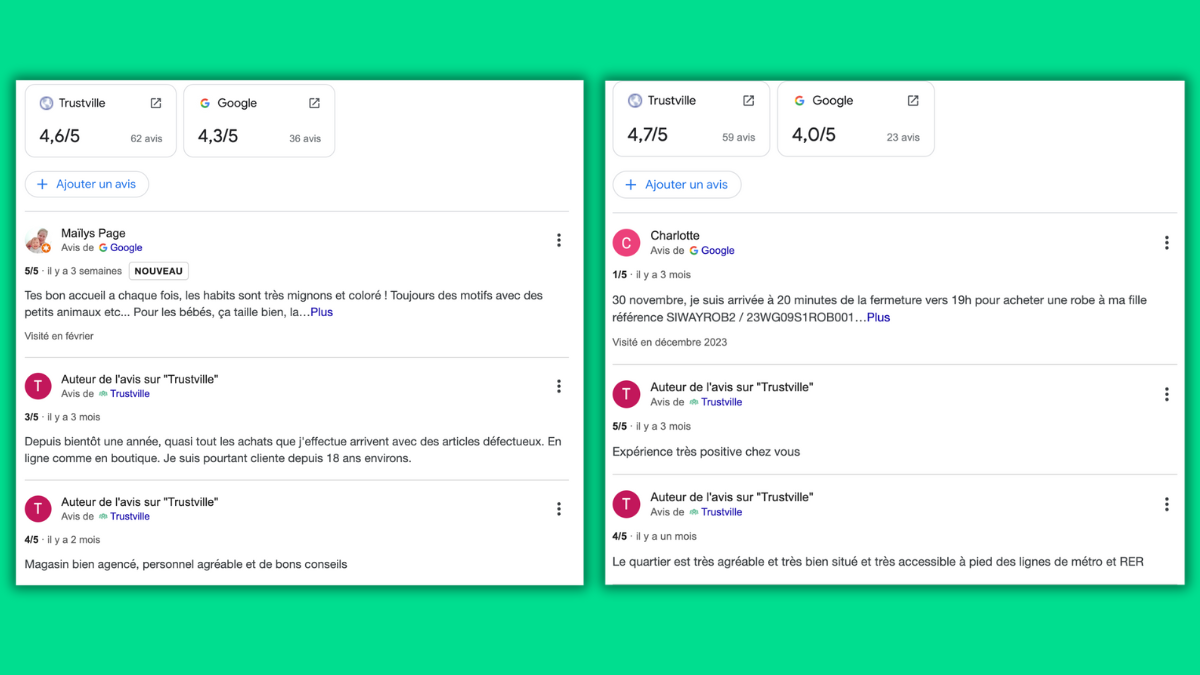
From now on, reviews verified by Trustville compete for visibility with Google's unverified reviews.
For businesses, this is a clear step forward: they can showcase authentic reviews, verified by a trusted third party, as evidence of the quality of their customer experience.
Even more importantly, it allows member businesses to take back ownership of their customer reviews. With the changes in visibility brought about by the DMA, businesses can regain control and proactively ask for feedback at different points in the customer journey, while counterbalancing the Google reviews over which they have no control.
Feel free to contact us if you would like to speak to a Trustville expert and find out more about our verified review platform.
Photo credit: alexfan32, Shutterstock




