







The impact of user-generated content (UGC) is hard to overstate.
Studies cited in 2024 found that nearly 78% of consumers say reviews from their peers are the source that most influences their purchasing decisions.
Customers are wary of what brands and retailers say about themselves and do not take it at face value. They do, however, place a great deal of trust in the opinions of other consumers and members of their communities.
UGC in itself is nothing new. People have always liked talking about the products they enjoy, and word of mouth has always shaped how brands perform.
What has changed is:
- The exposure of UGC: customer reviews and comments are now publicly available on a large scale, on the web and on social media.
- The fact that brands now use UGC as a marketing lever: rather than simply observing the trend, they take an active part in it.
Using UGC is a strong trend in retail, and it sometimes leads to questionable practices. Can content still be called user-generated when an influencer is paid to promote a product? Authentic UGC, on the other hand, helps to strengthen the customer experience.
This article explains how to put user-generated content to work for a better customer experience.
What is user-generated content (UGC)?
User-generated content (UGC) is original, brand-specific content created by customers, who share their experience of a retailer or a product in several forms:
- Reviews and testimonials: these are the most common forms of UGC. Customers who have bought and used a product share how they felt about the experience. Reviews appear on dedicated platforms (Google Business Profile, Tripadvisor, Trustville, etc.), on brand websites, in discussion forums and on social media. They carry a lot of weight in purchasing decisions because, in consumers' eyes, they provide authentic and impartial information on the performance and quality of a product or service and on what it is like to use.
- Photos and videos shared by customers using the products: this multimedia content gives an authentic view of how consumers use products in everyday life. It shows products in action and how customers interact with them. It helps other consumers identify with the user and picture themselves with the product, and it builds trust in the brand.
UGC appears on many channels, but publication on social media very often amplifies its potential to go viral. Hashtags and mentions play a big part in spreading it: they help users find the content easily, and let brands track it and share it on their own channels.
UGC has also multiplied on e-commerce product pages, where it makes it easier to convince a shopper to buy.
Why should brands take an interest in user-generated content?
Brands should take an interest in UGC because consumers trust it far more than brand content, and in most cases it costs nothing to produce.
There is nothing new under the sun here: customers have always shared their opinions on their favourite products in one way or another. The difference is that brands have now worked out how to benefit from this content.
The advantage of UGC for brands is twofold:
- The content is transparent and comes from a neutral source. It inspires much more trust in other consumers than content created by brands themselves.
- UGC costs nothing to produce (in most cases): at a time when brands have to make trade-offs on how they allocate their budget, UGC is a lever that is both powerful and free.
What matters now is how you make the most of this trend, with two underlying questions:
- How do you encourage your customers to create UGC?
- How do you identify the UGC you really need?
How can you encourage your customers to create UGC?
You encourage customers to create UGC by giving them a framework: a challenge, a reward for their photos and videos, or the prospect of seeing their content reused by the brand.
Customers are keen to share the things they love. The way social media works encourages consumers to showcase their experiences. When they highlight a product, they signal that they belong to a community that shares the brand's values.
They are not short of willingness to create UGC, but they sometimes need guidance. Without guidelines, UGC can quickly become chaotic, unstructured and impossible for brands to manage. It is therefore in your interest to offer a framework within which customers can express themselves.
Launch a challenge or a competition
Rather than waiting for customers to feature your products on their social media, you can set them a challenge that encourages them to create content.
Gamification is an excellent way to get them involved. You can also create a hashtag that brings all the content together under one banner and makes it more visible. A well-designed challenge encourages participation and friendly competition and, as GoPro shows, it can help you generate a steady stream of UGC.
Since 2018, GoPro has used its annual "Million Dollar Challenge" to mobilise its community and collect action videos shot with its cameras. Creators whose clips are selected for the final video receive a reward. The challenge has not only generated thousands of submissions; it has also become a pillar of GoPro's content strategy. By encouraging users to capture action moments, GoPro strengthens community engagement and promotes the use of its latest products.
Reward customers who share UGC
For some customers, the prospect of being featured on the social media of a brand they like is a strong enough motivation in itself.
If your brand already has a strong emotional connection with its audiences, that may be enough. Sometimes, however, a system of rewards is needed to speed up customer participation in creating UGC.
For example, you can offer discounts, coupons, gifts or loyalty points to customers who share their photos, videos or social media posts. Just make sure these rewards are relevant and proportionate.
One firm limit applies to reviews: never offer anything in exchange for a public review. Google's policies prohibit incentivised reviews, and the same goes for competitions and prize draws. An incentive is only acceptable for private feedback, such as a satisfaction survey.
You can also reward your "UGC contributors" by giving them access to an already engaged customer community. This gives them a VIP status that strengthens their desire to talk about your brand.
Reuse customer-generated content in your own marketing campaigns
Most brands simply repost customers' content on their social media accounts. You can go further in making the most of UGC.
Just like the marketing content you create in-house, UGC is made up of brand assets that you can reuse, with the permission of the customers who created them.
You can use UGC in your advertising (on social media, on the web, in print, etc.). In 2021, for example, Aldi launched a TV ad in which the brand replied to consumers' tweets. You can also feature your customers' photos on your website, in a gallery or on product pages, to show how the product is used by "real" people.
How do you identify UGC opportunities that genuinely improve the customer experience?
You find the UGC opportunities that matter by first pinpointing the points in your customer journeys where shoppers get stuck, then encouraging the content that removes those obstacles.
Although you cannot fully control the content users generate, you can encourage customers to produce content that is useful to the brand.
Taking a proactive approach can help you close gaps in your customer journeys. Before you start, identify the blocking points in the purchase journey that UGC could address.
Here are three UGC use cases that follow this approach.
Boost conversions with social proof
UGC is a powerful tool for strengthening social proof, that is, the validation of a product or brand by other consumers.
Whether you are converting customers online or in store, you can use content created by users to prompt other customers to take action.
In online customer journeys, product reviews contribute significantly to the purchasing decision. Integrating customer reviews, and even customer testimonials (on video, for example), enhances the customer experience: customers have more information to help them choose. UGC reassures them and boosts conversions.
You can also showcase UGC in the in-store experience. Augmented reality solutions such as Graffiti.ai give customers access to additional product information, including reviews and UGC. You can also play audio testimonials via a QR code with a solution such as Ekoo Audio Platform.
Show products in real-life use
In customer journeys, especially in e-commerce, retailers lose valuable conversion points when customers cannot picture themselves using the product.
Typically, a customer looks at a product page several times, hesitates and ends up not buying. In this case, the customer probably likes the product but is not sure it will suit them.
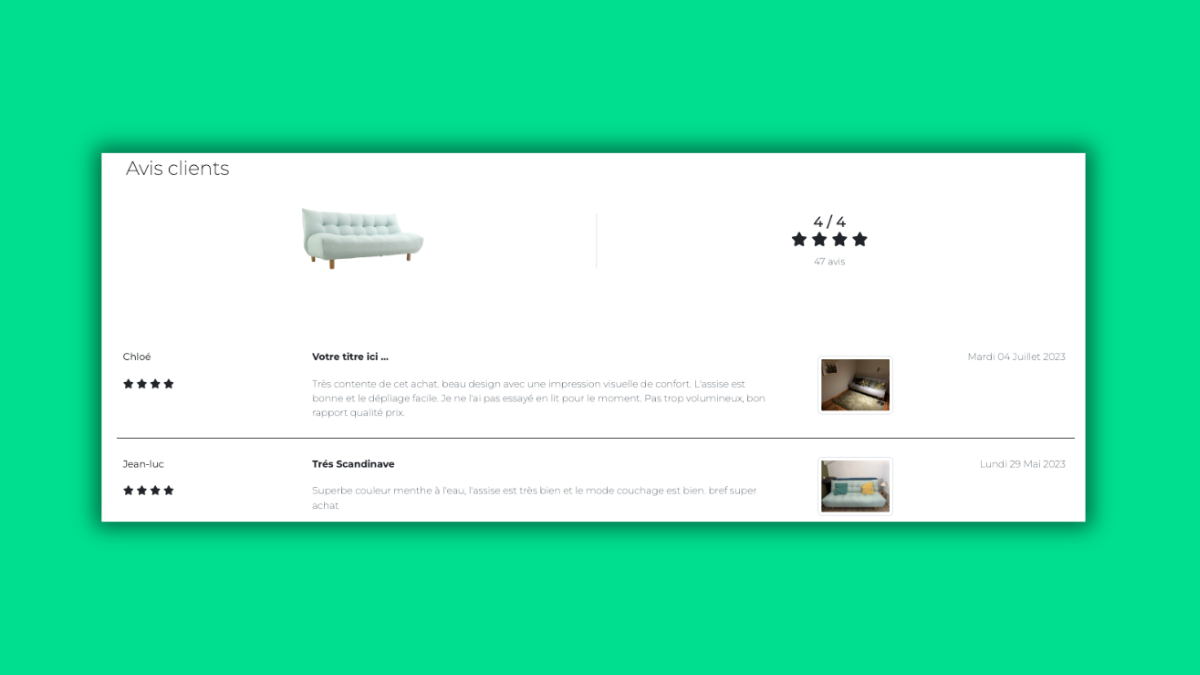
For example, consumers give up on buying clothes because they fear the item will not suit their figure. They hesitate over make-up because they cannot imagine how it will look on their skin tone. Or, when buying furniture, they cannot picture how a sofa will look in their home.
UGC helps to remove these obstacles. It gives you a wide range of content showing products in real-life situations. Among this content, most consumers will find situations close enough to their own to identify with them and picture themselves using the product.
The French furniture retailer Miliboo uses this lever by asking customers for reviews with photos, to show its furniture in context.
Integrate UGC into customer service
Brands often use UGC before the sale to boost conversions, but you can also integrate user-generated content at other points in the customer experience.
For example, UGC is useful after the sale to help customers get the most out of the product.
Community help forums, such as those run by the French electronics retailer Darty, encourage customers who have bought a product to answer other users' questions.
In customer service, if a customer asks how to use a specific product, you can also share a UGC video of another customer showing how they use it.
UGC also encourages peer-to-peer communication, rather than only top-down communication from the brand to the customer. In this sense, it is also a pillar of building a user community.
Retailers can use user-generated content to improve the customer experience. To get the full benefit, they should identify the blocking points in purchase journeys and encourage customers to share content that fills those gaps.
UGC is part of a broader marketing strategy. It becomes a brand asset and also contributes to return on investment. Brands can channel part of this flow of content towards their marketing objectives.
To do so, they can take a three-step approach:
- Encourage customers to share their experiences
- Reward customers for taking part (for photos, videos and posts, never for public reviews)
- Integrate UGC strategically into customer journeys
This approach strengthens the trust of prospects and customers, boosts conversions, and encourages engagement and a lasting connection with the brand.




