







Email remains the channel companies use most often to collect customer feedback. In 2023, 92% of Wizville clients used it in their programmes to accompany a customer satisfaction survey.
The channel has several advantages. It is almost free and fairly easy to use, and it offers a personalised, high-quality and relatively unintrusive way of asking for feedback. Compared with other channels, it delivers very good response rates (up to 50% in some programmes) as well as good-quality answers.
However, how well email performs depends heavily on the content of the invitation message.
To get responses, the recipient has to open your email, read it and agree to answer the survey. Your command of email deliverability best practice and the quality of your copywriting therefore have a strong influence on response rates.
In this article, we share our advice on writing the email that will make your customers want to answer your survey. We then show some examples of emails that generated above-average response rates.
Why does your survey invitation email matter so much?
Your invitation email matters because average email open and click rates are low, and only a carefully written message gets customers all the way to your survey.
Writing the email that accompanies a satisfaction survey is often a dreaded task.
Internally, everyone understands what is at stake: getting a significant response rate so that the analysis is as representative as possible. But whoever has to write the email often finds themselves alone in front of a blank page.
If you want to add to the pressure, talk to them about average rates.
According to the 2022 study by the Data & Marketing Association (DMA) (in French), the average email open rate was around 18.15% and the average click rate was 5.33%. In other words, a little under one recipient in five opened a given email, and roughly one in 20 actually clicked its call-to-action button.
The good news is that these are averages. By taking care over how you write your emails, you can beat them, sometimes by a wide margin.
To do that, you need to optimise your invitation message. This is essential to:
- Get past spam filters and make sure the message actually reaches your recipient's inbox
- Maximise the chances that the recipient opens the message
- Make sure they read it and understand it easily
- Encourage them to act and actually answer your survey
Each of these stages (you could almost call them checkpoints) has its own best practices, which will help move recipients towards your goal: a completed survey.
Here they are.
4 tips for writing the perfect satisfaction survey invitation email
To write an invitation email that gets answers, work on four things: the subject line, personalisation, the reason for the survey and the first question, embedded in the email itself.
#1. Take care over the subject line
A HubSpot study cited in 2023 found that 69% of email recipients report an email as spam based on its subject line alone.
A poor subject line is a bit like an automatic fail in an exam: it drastically reduces the chances that your recipient ever reads your message.
Ideally, the subject line should be fairly short and designed to make the customer open the message. There are two schools of thought:
- A subject line about the survey, such as "We'd love your feedback" or "What did you think of your purchase?". These classic hooks are the most widely used.
- A thank-you message, such as "Thank you for your purchase"
At Wizville, we have tested both options. We see better open rates on emails that combine a thank-you message with an invitation to complete a survey.
That may seem counter-intuitive, since the real purpose of the message is not explicit. But after a purchase, customers expect to be thanked. Gratitude prompts optimism and enthusiasm in return, and the customer feels valued. More prosaically, they know that a post-purchase thank-you email may contain important information about billing, their loyalty account or how to use the product.
For all these reasons, they are more inclined to open it. The classic approach, by contrast, feels like an extra chore that they can put off until tomorrow and eventually forget in the depths of their inbox.
HubSpot also put the open rate for thank-you emails at around 42%, far above the 18% average for B2C email marketing as a whole.
#2. Personalise your message
You can use personalisation from the subject line onwards to create a connection with the recipient.
Which of these opening lines seems more effective?
- Marie, thank you for your purchase!
- Thank you for your purchase!
The first has the merit of speaking to you directly. You are no longer one recipient among many, but addressed as an individual.
You can also use the customer's first name in the body of the message.
But personalisation obviously goes further than that. Remind the recipient of the context of their purchase or interaction with your brand. For example, you can remind them exactly where and when they made the purchase and which product they bought.
#3. Explain why you are running the survey
Giving up time to answer a survey is not something people do automatically. To encourage customers to take part, explain why you are running the survey and why their contribution matters.
In one sentence, you might say, for example, that the survey aims to improve the in-store experience or your products and services.
Be transparent about your goals so that the customer feels confident. If they have the slightest doubt about the purpose of your approach, they will choose not to respond.
#4. Include the first question in the body of the email
Your invitation email should be short, because many customers read their emails on mobile.
To maximise the click rate, your call-to-action (CTA) should sit above the fold. In other words, the recipient should be able to click it without having to scroll.
Finally, your goal is to get the customer into the survey. One technique is to include the first question directly in the body of the email before taking them to the survey page. Having already started answering, they will feel they might as well carry on.
With our clients, this technique increases response rates by 15 to 20%.
Examples: email templates to invite customers to answer your satisfaction surveys
A survey invitation email that applies these four tips combines a personalised subject line, a reminder of the purchase, a one-line reason for the survey and the first question. Here is a template:
Subject: Marie, thank you for your purchase on 5 February!
Hello Marie,
You recently bought (product) at our (store name) store. We hope you are completely satisfied with it.
To help us improve our customer experience, we would like to hear your opinion.
[NPS question] or [overall satisfaction question]
Thank you, and see you soon in our stores.
Of course, you need to adapt the message to your brand's tone of voice. Customers should recognise the tone you use on your other communication channels. But the key elements always remain broadly the same.
Below are three invitation emails sent by French brands. They are in French, but each one follows the same structure: a personal greeting, a reminder of the purchase and the first question (a 0 to 10 recommendation scale) embedded directly in the email.
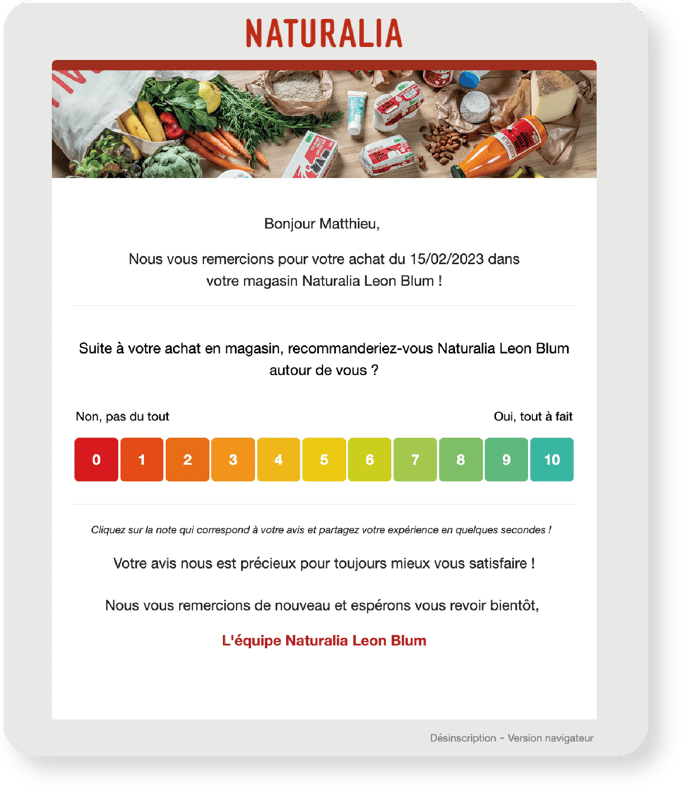
Naturalia: "Hello Matthieu, thank you for your purchase on 15/02/2023 at your Naturalia Leon Blum store! Following your in-store purchase, would you recommend Naturalia Leon Blum to the people around you?" A 0 to 10 scale follows, from "No, not at all" to "Yes, definitely", then: "Click the score that matches your opinion and share your experience in a few seconds!"
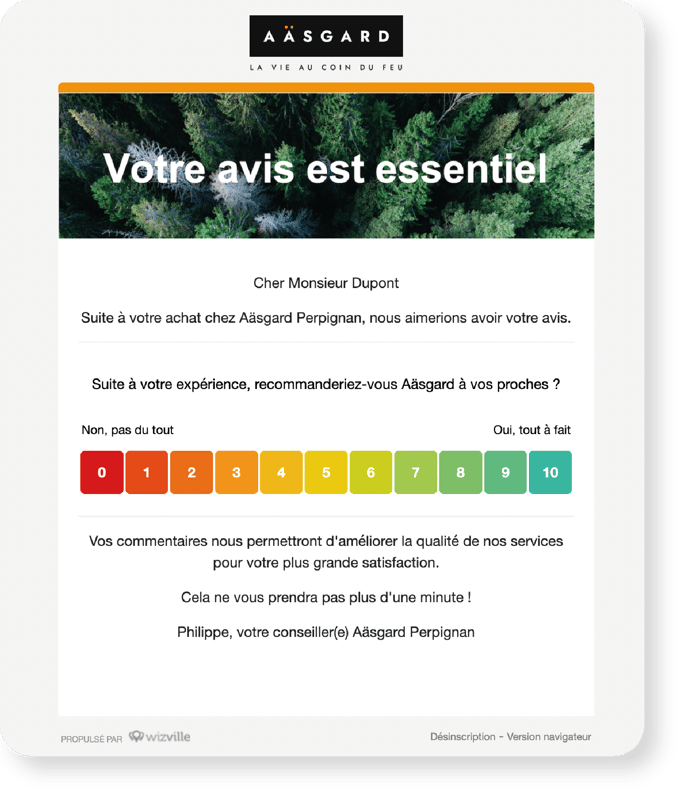
Aäsgard: "Dear Mr Dupont, following your purchase at Aäsgard Perpignan, we would like to hear your opinion. Following your experience, would you recommend Aäsgard to your friends and family?" Under the scale: "It won't take more than a minute!", signed by "Philippe, your Aäsgard Perpignan adviser".
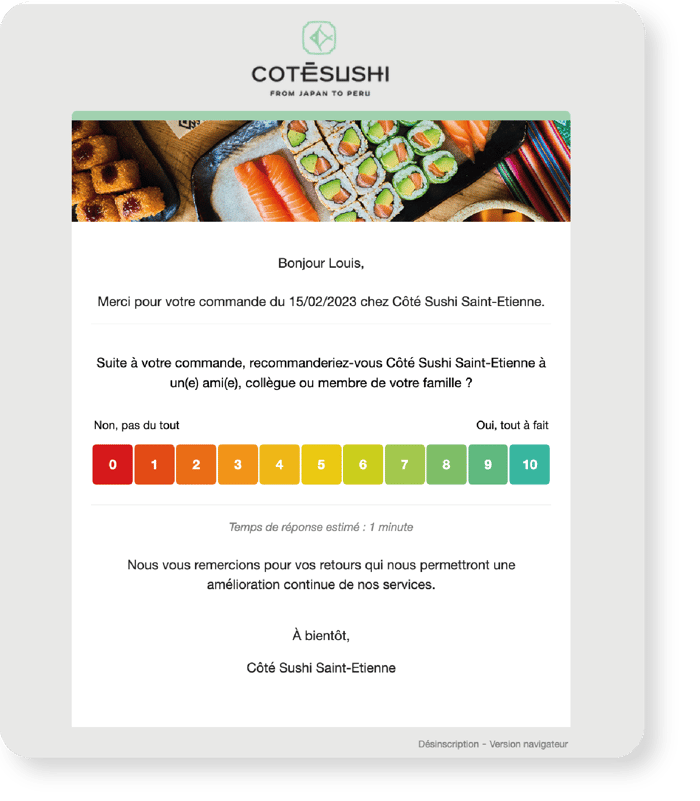
Côté Sushi: "Hello Louis, thank you for your order on 15/02/2023 at Côté Sushi Saint-Etienne. Following your order, would you recommend Côté Sushi Saint-Etienne to a friend, colleague or family member?" Under the scale: "Estimated response time: 1 minute".
Conclusion
The content of your invitation email has a major impact on your response rate, and following these tips should improve your results.
However, other factors also affect the success of your surveys:
- When the email is sent
- Who the sender is
- Reminders
Need help setting up your customer feedback collection programme? Talk to one of our advisers.




