







Every year since 2008, the Whitespark platform has published a survey of the factors that affect local visibility on Google. This article, written in early 2022, gives an operational summary of the 2021 edition and sets out the main changes in local SEO compared with 2020.
So what are the key takeaways from Whitespark's 2021 study on local visibility?
Google My Business was set to become Google Business Profile, with new features
At the time of the study, Google had announced that Google My Business (GMB) would be renamed Google Business Profile (GBP) during 2022, as part of an effort to simplify and unify its local visibility tools.
Beyond the new name, the change had a deeper implication: simpler management of business profiles. From the new platform, businesses would be able to access and manage their profile directly in Google Search and Google Maps (and in their respective apps).
As a result, there would be a single, central place to manage local visibility and customer reviews. This was much simpler than before, when businesses had to juggle Google Search and Google Maps (and their respective APIs).
It was a concrete effort by Google, begun around three years earlier and accelerated by the Covid-19 crisis, to upgrade the poor relation of its product range and make it easier for businesses to manage their local image.
New features
Alongside the platform merger, Google announced a series of new features for businesses, without a fixed timetable at the time:
- a business profile manager to help large companies with many points of sale manage their multiple stores more easily;
- new messaging options, including direct messages, read and delivery receipts, and a call history from a Google result (then being tested only in Canada and the United States);
- more options to showcase a product catalogue (outside Google Shopping) through the business profile manager, notably the ability to mark certain products "as special" to place them at the top of the list. This was still being tested in the United States; it remained to be seen how the option would reach France, since Google My Business product catalogue features are limited in the European Economic Area.
The most important local ranking factors in 2021-2022
According to Whitespark's 2021 study, the most influential local ranking factors are those linked to the Google Business Profile listing itself, followed by customer reviews.
As a reminder, for its annual comparative study of local SEO and local visibility, Whitespark groups local ranking factors into the following categories:
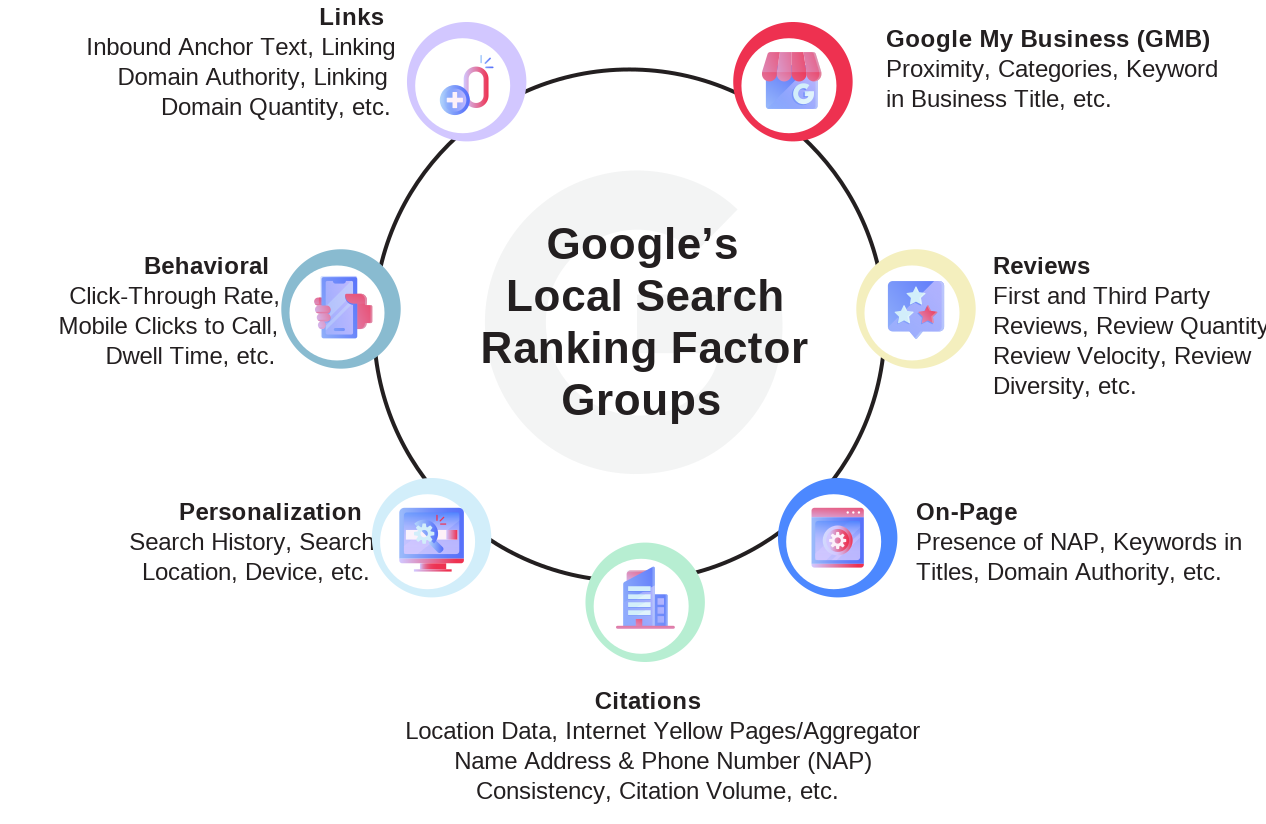
Image credit: Whitespark
From its year-on-year comparison, Whitespark observed the following changes:
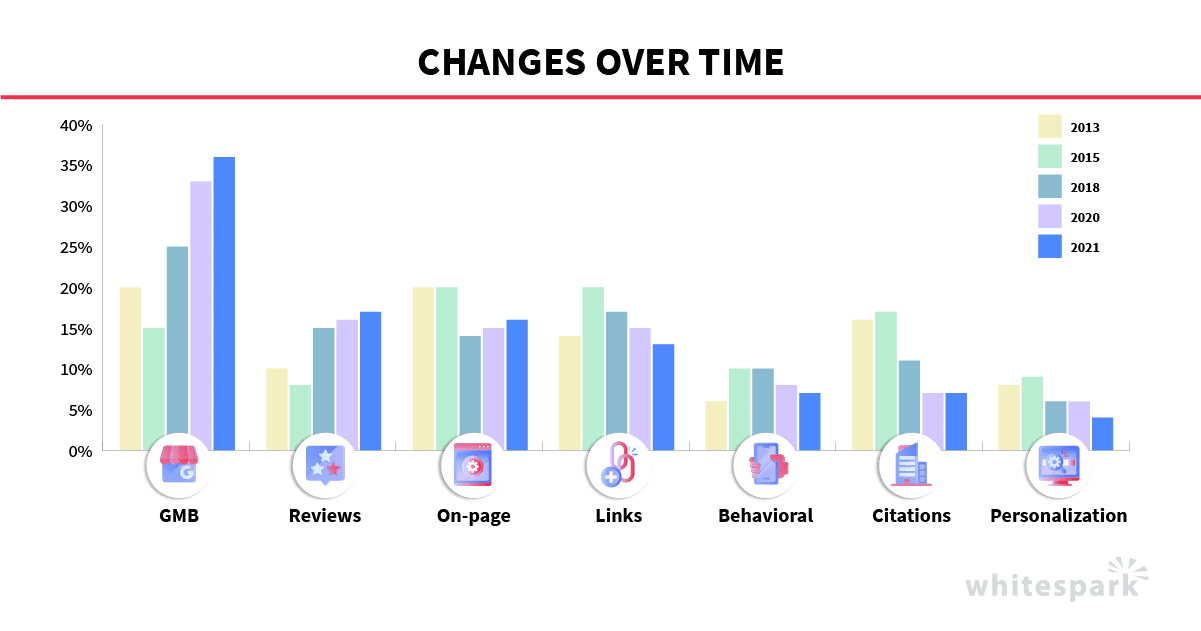
Image credit: Whitespark
We will now look at the factor categories that rose the most and now carry the most weight in local visibility. There are two of them.
Customer reviews
The first is customer reviews left about a brand or business.
In the 2021 study, this category remained one of the most important (second only to Google My Business signals for the local pack), and its weight has grown with each edition since 2015.
This is logical, and it shows how valuable it is to handle your customers' Google reviews, both positive and negative.
In practical terms, working on this category means:
- Working on the variety of reviews collected, both directly (first party) and indirectly (third party): diversifying where your reviews come from, on Google first of all, but also on other platforms (TripAdvisor, Apple, Facebook and so on, depending on Google's local ecosystem in each country) and directly on your own website.
- Operational recommendation:
- Although there is no official list (yet) of Google My Business trusted partners, the main recommendation is to spread your marketing efforts so that reviews feeding your Google profile also come from outside Google itself.
- Any website with structured data for a local business may be displayed by Google.
- In practice, however, Google mostly displays its trusted partners in each country in local results, such as TripAdvisor, Partoo, Pages Jaunes and Orange in France.
- Finally, it is highly recommended to also collect reviews of your brand and stores directly on your own website (with the same structured data set-up).
- Operational recommendation:
- Working on the diversity of reviews collected (a mix of negative and positive reviews): building a review profile that looks natural rather than smoothed over.
- Operational recommendation:
- Perhaps surprisingly, the main recommendation here is not to despair about reviews below five stars.
- For Google, a profile that is too perfect (only five-star reviews, or an extremely high ratio of them) is somewhat suspicious.
- Reviews from people who leave constructive comments and give a store an imperfect rating are therefore, indirectly, a good thing. But this also means handling and replying to dissatisfied reviews, to show Google that you take them into account.
- Finally, in your marketing campaigns, do not try to push customers towards a biased rating, and always reply positively, especially to negative reviews.
- Operational recommendation:
- The total number of reviews on the Google My Business listing: simply working to get as many reviews as possible.
- Operational recommendation:
- Overall, the best recommendation is to allocate budget and marketing actions to encourage all your customers to leave a review on Google after their purchase (email, SMS, QR code and so on).
- This is broadly what Wizville offers: at the end of a satisfaction survey, respondents are invited to post a review directly on Google, based on their survey answers. To respect Google's rules, this invitation must be offered to every respondent, whatever their score.
- Operational recommendation:
- How often new reviews arrive (review velocity): the regularity with which each of your stores receives new customer reviews.
- Operational recommendation:
- As above, but make sure you encourage customers to leave reviews at a steady, regular pace.
- Operational recommendation:
The Google My Business profile
This is the factor category that saw the biggest increase in 2021, as in previous years.
Factors linked to the Google My Business profile now account for more than 35% of a listing's local visibility (36% in the 2021 study).
In detail, these are the five most important factors in this category:
- The primary category of the GMB listing: the category to which a business or store is attached.
- Additional categories: the secondary categories that can also be assigned to the store.
- A strategic keyword in the listing title: a keyword matching a search term that triggers a local result on Google.
- Proximity of the listing's address to the searcher: the physical distance between the store and the location of the person searching.
- Presence in the city searched for.
- Operational recommendation:
- Paradoxically, despite its weight, this is not the category that will take up most of your time. Of the five main factors, only two can be acted on directly:
- the listing title must be the business's real name. Google's guidelines forbid adding keywords to it, even though, in some highly competitive markets such as the United States (notably among lawyers), keyword stuffing in the name remained a widespread practice that still unfortunately worked at the time;
- short of moving, you cannot change your geographical location;
- so you can only work on your business's primary and secondary categories. It takes five minutes, but the impact is very significant.
- Always choose the category closest to your main activity. A list of Google My Business categories (in French) can help you choose.
- Do the same for secondary categories, treating each extra category as an extra keyword.
- There is no risk of diluting your visibility by having too many secondary categories, as long as your choices stay relevant and consistent.
- Paradoxically, despite its weight, this is not the category that will take up most of your time. Of the five main factors, only two can be acted on directly:
- Operational recommendation:
Other categories
To finish, a few points on the categories not covered above:
- On-page factors (on your website: local keywords in the title tag, domain authority and so on).
- They remain important, but less so than in 2013-2015. We look at this category in more detail below.
- Links (anchor text, internal linking, domain authority of inbound links) continued to decline but remain significant. We also come back to this category below.
- Citations (a store's presence in local aggregators and directories such as Pages Jaunes, consistency of NAP data: name, address, phone number) were seen as declining, but this should probably be put into perspective, given what we saw about reviews and the importance of a varied source profile.
- One citation-related lever that seems to have a significant effect on local visibility is earning hyper-local links and citations, from media and radio stations in the same area, chambers of commerce and so on.
- Personalisation (browsing history and device) and behavioural signals (click-through rate, call rate and so on) continued to lose importance and became secondary.
- This decline is probably linked to the major changes Apple made to data tracking, notably with iOS 14.5. It became relatively counter-productive for Google to give too much weight to hyper-personalised results that would inevitably be skewed, especially on mobile.
Focus: local ranking factors weigh differently in local organic results and in the local pack
The weight of each category of local ranking factors varies greatly depending on the type of local search results page (SERP) Google displays.
There are three formats:
- Local organic results: the standard results for a search with a local dimension ("restaurant Paris"), very often shown below the local pack.
- The local pack: shown at the top of local search results as a list of businesses taken from Google My Business, with a map.
- The local finder: shown for some local searches with high search and result density; it is an extended local pack, with a larger map and more Google My Business results.
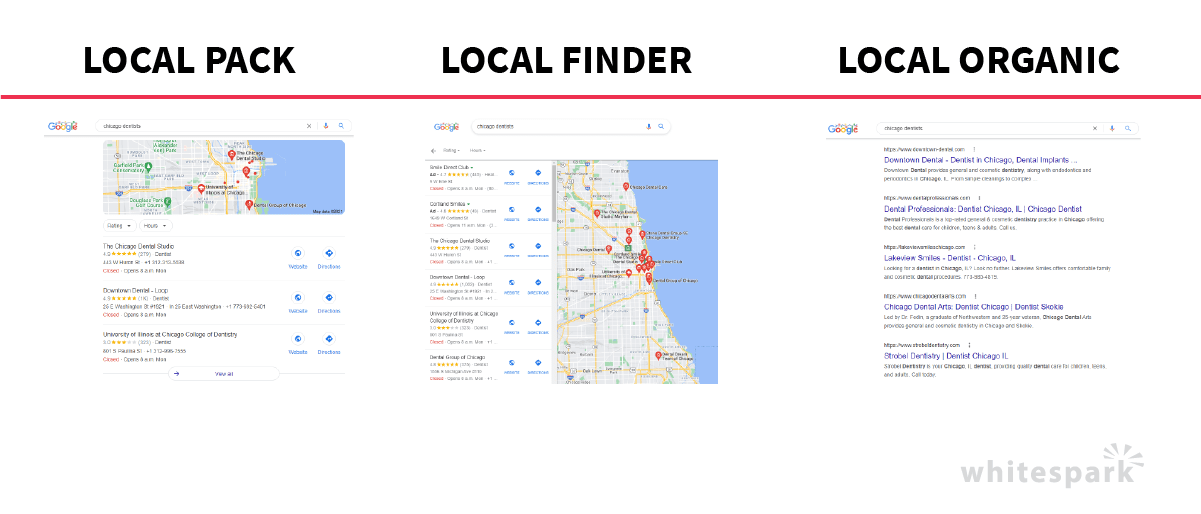
Image credit: Whitespark
Whitespark's study highlights the following differences in weight:
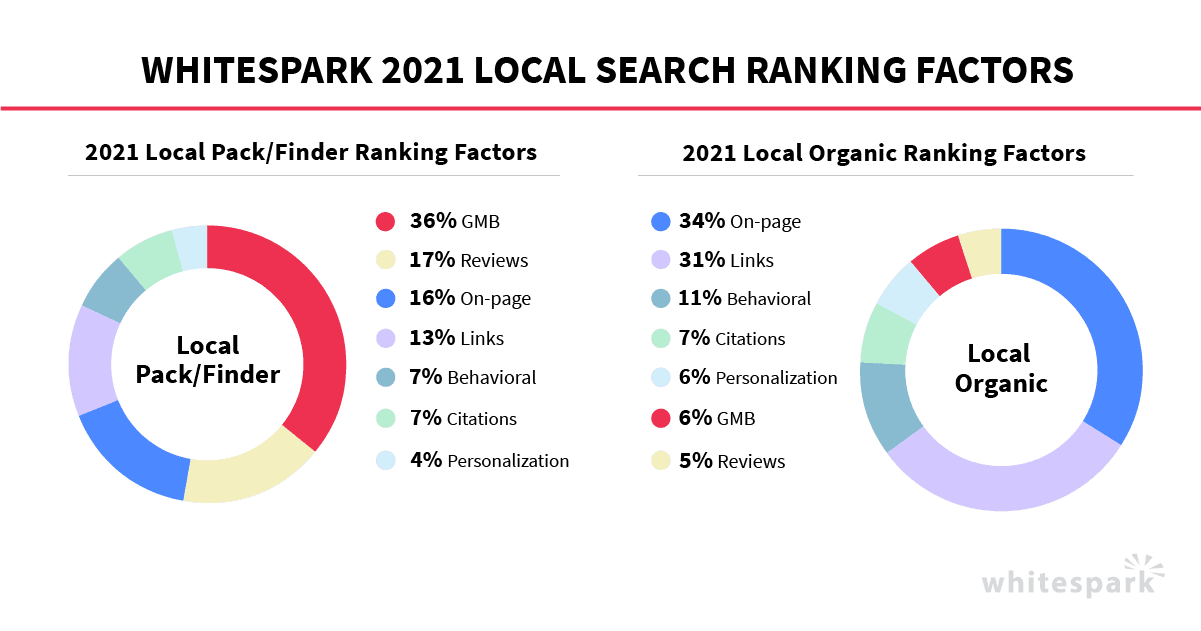
Image credit: Whitespark
Local pack
The local pack, Google's main local visibility feature, is driven mainly by the categories covered above: the Google My Business profile and customer reviews.
But the 2021 Whitespark study also highlighted several additional points to maximise a listing's visibility:
- Removing fake or defamatory reviews has an impact on local visibility.
- Operational recommendations:
- Have reviews collected outside Google moderated by a certified partner, or follow AFNOR's recommendations on review collection.
- Although you cannot remove constructive negative reviews, you can ask Google (via "Flag as inappropriate") to remove reviews that are clearly personal attacks, defamatory, racist or intimidating.
- Operational recommendations:
- Make sure the map pin is correctly placed for your listing's address.
- Operational recommendations:
- Proximity is a key element of the local search algorithm, so it is essential to check that the location pin on the map is in the right place for your address.
- To do so, go to your Google Business Profile, open the Info section, then Address, and check the pin's position.
- Operational recommendations:
- Internal linking across the whole website attached to the Google My Business listing.
- Operational recommendations:
- First, make sure each store's Google My Business listing has its own landing page on the main website, properly indexable (in HTML).
- Then make sure internal links between the site's pages are balanced (no glaring imbalance with some pages receiving all the internal links and others none), particularly for store pages on the main site.
- Still on internal links: as the weight of keywords in anchor text continues to fall, do not over-optimise the anchor text of links to store pages, but include a geographical reference where possible ("store in Bordeaux", "store in Paris 15th" and so on).
- Operational recommendations:
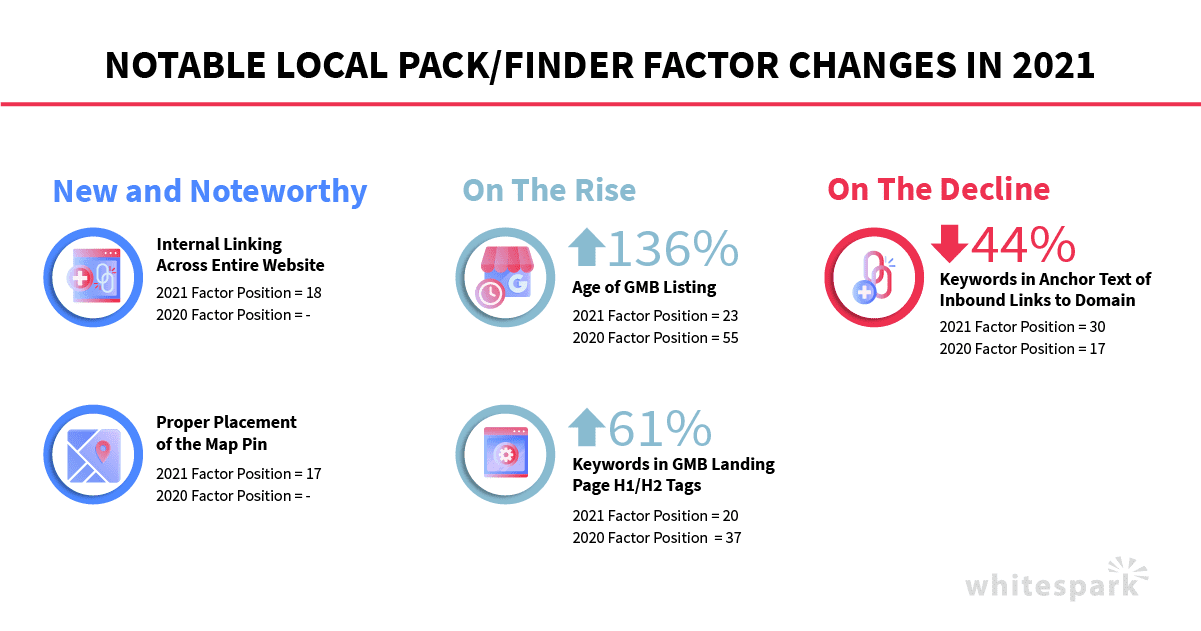
Image credit: Whitespark
Local organic
Focusing on the local pack makes sense given its prominence in Google's results, but you should not neglect optimising the standard results for a local query.
Traditional search results go hand in hand with the local pack, notably through the store pages on the main website. These pages are connected to the corresponding Google My Business listings and pass more authority to them through internal linking.
Store pages often repeat the information found on Google My Business, but they offer extra room for customisation:
- There are no naming restrictions on your own site, so you can more easily include a strategic keyword in the title tag and page title (H1 tag).
- You can do the same for subsections (H2, H3 tags and so on). In the latest Whitespark study, the importance of strategic keywords in H1 and H2 tags rose by 61%.
- Do the same with URLs, which should be short and descriptive.
- Design these pages for a smooth (UX/UI) and responsive user experience.
- Add a block of text describing the location ("near…") so the page can appear for other types of local queries ("wine bar near the Louvre").
- Highlight the services specific to that store (click and collect, wood cutting, delivery and so on) with icons, and/or current promotions.
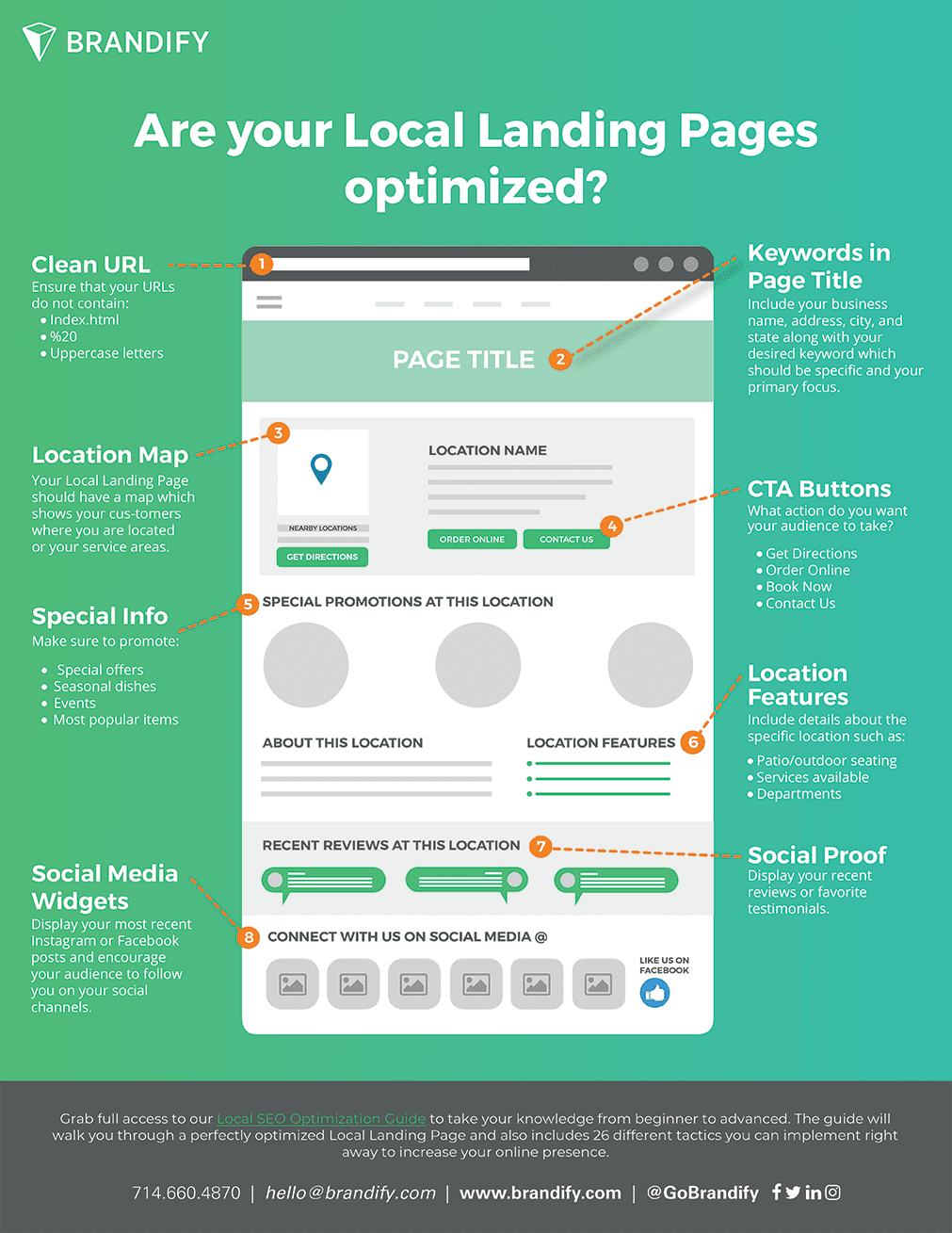
Image credit: Brandify




