







Purchase decisions rest on trust. Consumers choose a product or service because, after weighing it up, they believe it will meet their need or solve their problem.
For retailers, building trust before the sale is therefore essential. A strong brand that consumers identify with can help. But a brand is often no longer enough: consumers tend to distrust what brands say about themselves, whereas they trust their peers. Customer reviews, and product reviews in particular, rank among the top three purchase criteria.
Product reviews provide social proof and influence decisions. To have an impact, however, a handful of scattered reviews is not enough. Review volume matters just as much as review quality.
Below a certain threshold, reviews have little influence. You need a critical mass of reviews (at least twenty or so) to show that a product is popular, give a representative picture of customer satisfaction and boost conversions.
This article sets out the tactics to adopt to optimise your product review collection and increase your review volume.
How does product review volume affect consumer trust?
A higher volume of product reviews makes a product look more popular, more reliable and more representative of general opinion, so consumers trust it more.
Imagine you are looking for a product online. You are hesitating between two items that both seem to meet your need. You have the two product pages open on your screen and start to compare them.
Your eye is quickly drawn to the customer reviews. The overall rating is almost identical. But the first product has 8 reviews, while the second has 76.
Which product will you choose?
Most consumers will opt for the one with more reviews, for several reasons:
- A large volume of reviews is seen as more representative of general opinion and therefore more credible. 65% of consumers trust the number of reviews (in French). The number reassures them about their choice: they see it as a sign of popularity and reliability.
- Consumers tend to read between 5 and 20 reviews to form an opinion of a product or service. The more reviews you display, the more material you give them to inform their thinking.
- Review volume is the third most important criterion for consumers when reading reviews, after recency and overall rating. In practice, consumers do not separate these criteria. They weigh the overall rating against the number of reviews, and recency is often a consequence of volume. If you always have recent reviews to show, it means you have set up an effective product review collection programme, with a steady flow of new reviews.
5 tactics to increase your product review volume
The most effective ways to increase product review volume are to ask every customer after purchase, make leaving a review effortless, think twice before offering rewards, display reviews prominently and rely only on verified reviews.
Review volume affects your e-commerce conversions, and potentially your in-store sales too.
82% of shoppers research products online before buying in store. Product reviews carry even more weight for high-priced products: consumers want to minimise risk and are more inclined to follow the majority view.
You therefore cannot simply wait for customers to post a review. You are better off taking a proactive approach to collect and display as many reviews as possible to help your customers make their decision.
Here are several tactics you can use to increase your product review volume.
Encourage reviews after purchase
The first step to increasing product review volume is to ask customers proactively after purchase to share their experience.
In Wizville's programmes, the product review request is built directly into satisfaction surveys to boost responses. This approach collects product reviews from more than 15% of buyers after purchase, compared with 2 to 4% in general.
Collection rates naturally depend on the timing of the request. It needs to be close enough to the purchase for the experience to be fresh, yet late enough for the customer to have actually used the product. Timing will therefore vary by product type. For everyday consumer goods, a few days may be enough. For more complex products such as electronic devices, one to two weeks is more appropriate.
To maximise responses, a good practice is to personalise and contextualise your message. Start by thanking the customer and reminding them of the purchase (include product photos) to motivate them to share their experience.
Also explain why product reviews matter and how they help other consumers choose the right product. Your message could include a line such as: "Your review helps other customers make the right choice and helps us improve our products."
You can also include examples of other customers' reviews to encourage new ones. For example: "Here is what François thought of the XXX printer. What did you think?"
Finally, if a customer does not respond to the first request, you can send a reminder a few days later. Again, timing is everything. Sending reminders too close together risks causing dissatisfaction. Limit yourself to one or two reminders, well spaced out.
Simplify the review process
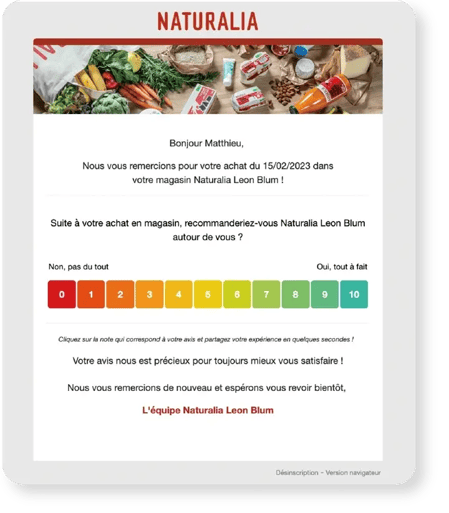
To collect more product reviews, you need to make leaving a review as smooth as possible. This means identifying and removing the friction that could discourage customers from sharing their experience.
First, you can make leaving a review a "zero-click" experience: customers give their review directly in the email, or in reply to the text message they received, without being redirected to another page. Customers find it easier to give a rating first and explain it afterwards. Let them leave just a rating, then invite them to add a comment.
In terms of user experience, you should also make sure the review form is accessible and responsive on every device, especially mobile.
Is offering rewards for product reviews a good idea?
No: offering something in exchange for a public review is prohibited by platforms such as Google and undermines the credibility of every review you display.
Given how much review volume matters, you may be tempted to offer incentives to encourage customers to share their experience:
- Discounts
- Vouchers
- Gifts
- Experiences: access to previews, private sales and so on
- Loyalty benefits
These practices raise serious questions. Financially, they generate significant costs just to increase your volume. Above all, the approach is ethically questionable. Will a customer who has been paid stay honest, objective and authentic about their experience?
Regulations state that businesses must never influence the content of a review or encourage only positive ones. Google's policies go further and forbid offering anything in return for a public review. An incentive is only acceptable for private feedback, such as a satisfaction survey. It is therefore better to encourage authentic reviews "validated" by a third-party verified reviews platform, and to ask all your customers, not just the satisfied ones.
Display product reviews prominently
Displaying reviews prominently increases collection because customers are more willing to share their opinion when they can see that reviews are valued and genuinely useful.
If you want more product reviews, you need to show customers that you value them.
The way you display reviews also influences collection. Customers are happy to share their opinion, provided it is genuinely useful. Yet the effect of reviews on your product offering or range is invisible to customers. What they do see is how you display reviews.
This starts with where you place reviews. Integrate them directly on product pages, ideally close to key information and the buy button. They help customers confirm their decision based on feedback from other buyers.
You can create a dedicated review section on each product page, with filtering and sorting options. Think of Amazon pages, which make it easy to display the best and worst reviews by rating.
Beyond your website, you can also share product reviews on your social media or use them in advertising campaigns, as user-generated content. This maximises the exposure and impact of your customers' reviews and recognises the customers who take part.
Finally, respond to reviews to show that you value customer feedback. Customers who read reviews also read your replies, which often reveal the kind of customer relationship you offer.
Rely exclusively on verified reviews
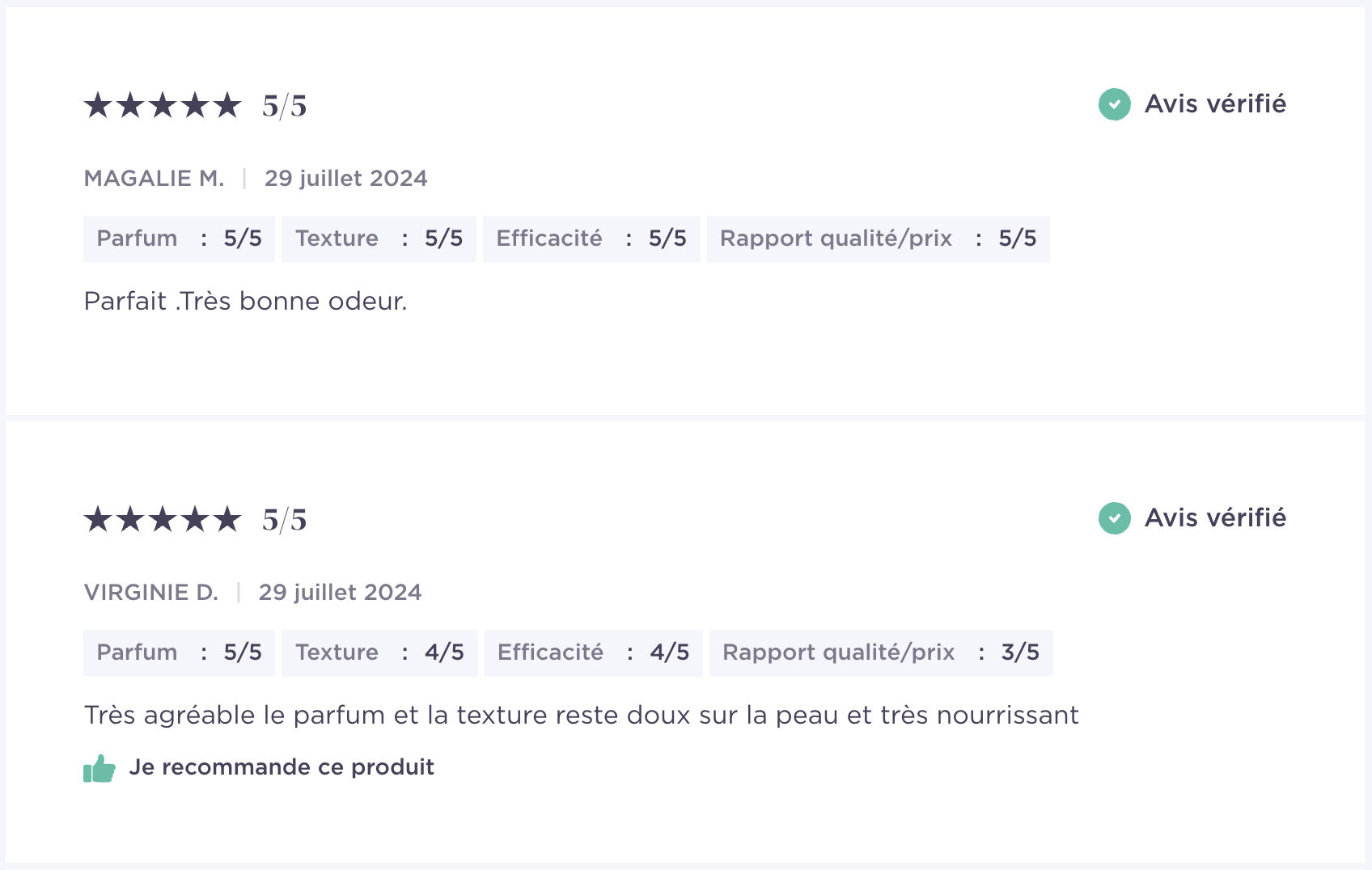
Relying only on verified reviews increases volume over time, because genuine customers are more willing to contribute when they know their review will not be drowned out by fake ones.
This may seem counter-intuitive if your goal is to increase the number of reviews. You may think you will get more reviews if you are less particular about where they come from. Over time, though, that is a very poor calculation.
Customers are less easily fooled by overly polarised reviews than they used to be. They are starting to recognise fake reviews generated by bots, and at the very least they know such practices exist.
To win their trust, a guarantee that the reviews in front of them are authentic and verified as such is becoming an expectation.
If you display unverified reviews, genuine customers will be reluctant to share their experience. What is the point if their feedback is drowned in a mass of inauthentic reviews?
Want to optimise your product review collection and build more trust? You need a proactive approach that values authenticity and transparency.
In Wizville's programmes, customer review collection is included in our satisfaction surveys. This approach limits the number of requests, maximises response rates and builds a substantial volume of verified reviews (linked to proof of purchase).
Want to boost your conversions with product reviews? Talk to one of our experts.
Photo credit: Shutterstock - ARMMY PICCA




